Shohei Ohtani's October Dilemma Is Rewriting How Baseball Thinks About Rosters
The Dodgers face an impossible choice with Shohei Ohtani: preserve his offense or keep his pitching alive for the postseason. The answer will redefine two-way play in MLB.
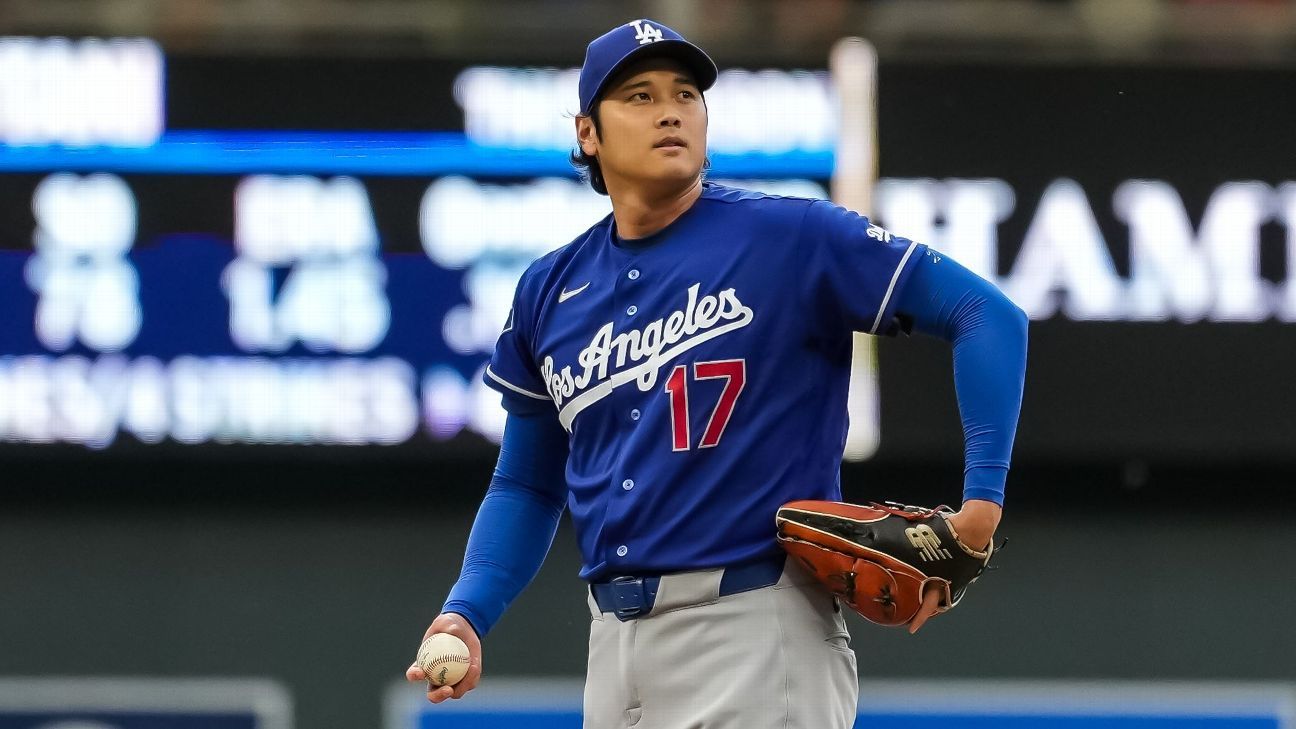
The Tip of the Iceberg
When Shohei Ohtani swung through a slider in the 10th inning on Wednesday night, something was visibly wrong. His lower half offered no support. After his fourth strikeout of the game, he walked back to the dugout shaking his right arm.
To some Dodgers officials, that was the first clear evidence that the same injuries keeping Ohtani off the mound since July 3 were now bleeding into his hitting. To manager Dave Roberts, it was merely the tip of the iceberg.
Ohtani missed Thursday’s game – his first absence since July 30 – described as day-to-day. The hope is that a couple of days off will restore him enough to be dangerous offensively. But the pitching side of his game remains clouded, and with the postseason less than a month away, the Dodgers are confronting a decision that no team in MLB history has ever had to make this way.
What Do They Need Most: The Pitcher or the Hitter?
Roberts was unequivocal on this question over the weekend. “His value offensively is hugely important,” he said. “And so we can’t compromise that in any fashion.”
The logic is almost brutal in its simplicity. Without Ohtani, the Dodgers still possess arguably the best postseason rotation in baseball. Tarik Skubal, the reigning two-time American League Cy Young winner. Yoshinobu Yamamoto, brilliant last fall and again this season. Blake Snell, posting a 1.17 ERA in four starts since returning from the injured list. Tyler Glasnow, equally sharp in his own IL return.
The offense, by contrast, has flatlined. Since the start of July, Dodgers hitters rank 22nd in OPS (.703), 23rd in runs per game (4.2), and 22nd in wRC+ (94). Kyle Tucker, Teoscar Hernandez, and Tommy Edman all slumped in August. Freddie Freeman went 47 games without a home run before finally breaking through Wednesday. Mookie Betts, already dealing with what many called the worst offensive season of his career in 2025, has been even worse in 2026.
It is easy to envision a championship path for the Dodgers that does not include Ohtani throwing a single postseason pitch. It is nearly impossible to envision one that does not include him driving in runs.
The Physics of Two-Way Decline
The question of whether pitching impacts Ohtani’s hitting has long been debated inside the Dodgers organization, and the data offers no clean answer. In 2023, his final full two-way season with the Angels, he slashed .372/.490/.731 on days he started. This year, on start days, he’s hitting .250/.372/.500. On days after a start, .250/.478/.500. On every other day, .288/.383/.542.
Health changes everything.
Ohtani’s current slump – seven hits and 20 strikeouts in 51 at-bats – has been variously attributed to poor pitch selection and the natural lulls any hitter experiences. But the mechanics visible in Wednesday’s final swing told a different story. The Dodgers had not heard him complain about discomfort while hitting, Roberts said, until that moment.
“If you’re not a hundred percent, there’s possibly some bleed-in to the performance offensively,” Roberts admitted. “That’s just me kind of theorizing.”
The theory now has a body to attach it to.
How Much Pain Is Too Much?
Roberts offered a revealing comparison when announcing Ohtani would not start on Sunday. “If any pitcher was feeling like this, we wouldn’t run him out there,” he said.
That is not the language of someone who believes his star is close to full fitness. Ohtani spent June managing left-knee pain while still producing a 1.091 OPS, then took a break from pitching in July. It has been two months, and the pain persists – even after a abbreviated 20-pitch bullpen session last Friday, cut short by soreness in the same knee and his right bicep.
He has tried adjusting his landing leg position to ease the irritation in the left knee, the same one operated on in 2019 to address a rare congenital condition called bipartite patella. The adjustments have not worked. The bicep issue, which flared weeks ago, has returned.
“I just don’t see everything getting to 100% by the end of the season,” Roberts said. The qualifier matters: Ohtani performs two roles, making pain tolerance a far more complicated equation than for any traditional pitcher.
The Vanishing Stolen Base
There is one dimension of Ohtani’s game where the data is unambiguous. His baserunning has largely disappeared since he resumed pitching duties.
From 2021 to 2023, as a two-way player with the Angels, he stole 57 bases. In 2024, his first full season as a Dodgers designated hitter, he stole 59 – and by late April 2025, he had already accumulated nine, four shy of the major league lead. Then he began building up as a pitcher, and the numbers dropped off a cliff: 16 stolen-base attempts over the past five months of the 2025 season, 14 total in 2026, including zero in June and July.
Since May 2025, he’s been worth 3.6 baserunning runs above average – still 25th among qualifiers, meaning his speed shows when the opportunity arises. In 2024, he was worth 9.8, second most in the majors.
The question is whether pausing his pitching regimen would unlock a more aggressive Ohtani for the stretch run. The answer, from at least one high-ranking Dodgers official, was characteristically blunt: “Absolutely not.”
In the postseason, where runs are at a premium and teams resist risky stolen-base attempts, baserunning matters less. Sacrificing potential mound value for base-stealing upside makes little strategic sense.
The Option That Costs Nothing
Here is where the Dodgers’ calculus becomes genuinely fascinating – and where Ohtani’s uniqueness is reshaping how front offices think about roster construction.
Ohtani does not count as an extra pitcher. He occupies no additional roster spot. If he can throw even a handful of innings in the playoffs, the Dodgers gain something近乎 free: a reliever who can also hit, or a starter who can ease the burden on a bullpen that has its own anxieties.
Consider the scenarios. Ohtani opens Game 1, giving Glasnow an extra day of rest. Or it’s the ninth inning of a tight game, and the Dodgers have Edwin Diaz – still struggling – or Roki Sasaki – still battling a blister – as their only viable late-inning options. Having Ohtani in the back pocket, even at less than full strength, changes the equation.
There is no firm timetable required. Ohtani can continue throwing off a mound before the end of September, work with plyometric training balls, and remain available for whatever limited role makes sense. Roberts confirmed Wednesday that shutting him down as a pitcher entirely remains “an option.” But it is a decision that requires Ohtani’s blessing.
“It’s his decision, honestly,” Roberts said. “If he feels like he’s capable, then we’ll run the play out until it doesn’t make any sense.”
What This Reveals About Baseball’s Future
The Ohtani situation is not merely a Dodgers problem. It is a stress test for an entire sport still grappling with what it means to have a player who refuses to fit into any existing category.
Traditional roster construction assumes specialization. Pitchers pitch. Position players hit. The margins between roles are narrow and carefully guarded. Ohtani collapses that architecture entirely – and in doing so, exposes how fragile that architecture was to begin with.
The Dodgers’ dilemma is this: they can protect the asset that matters most right now (his bat) or preserve the option that could matter most later (his arm). Either choice carries risk. The choice not to decide carries its own.
What happens next will reverberate far beyond Los Angeles. If the Dodgers successfully navigate this, they will have solved a problem no team has faced. If they stumble, they will have proven that even the most resource-rich organization in baseball cannot always optimize the extraordinary.
The postseason begins before the answer is clear.