How SK Hynix and Samsung's Payouts Are Rewriting Korea's Chip Cycle
SK Hynix and Samsung Electronics just announced a combined shareholder return plan exceeding 130 trillion won. The move signals a structural shift in Korea's memory-chip boom — and a bet that the cycle has a long runway.
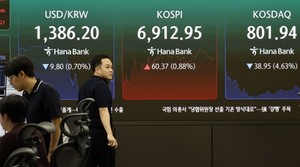
The Market Shook. Then SK Hynix and Samsung Stepped In.
The Korean stock market stumbled into the third week of August with a 5.8 percent drop that briefly pushed the KOSPI below 6,500. Geopolitical noise did the damage: worsening US-Iran negotiations drove oil prices higher, inflation fears pushed the US 30-year bond yield to levels not seen since 2007, and anxiety mounted that rising borrowing costs could choke off the AI investment boom.
Then came the counter-move. SK Hynix announced a 40.4 trillion won share repurchase and cancellation program on August 19. Samsung Electronics followed two days later with a 90 to 110 trillion won shareholder return plan. The KOSPI reclaimed 6,900 by close. The day-by-day reversal was dramatic: SK Hynix shares surged 12.7 percent, Samsung jumped 9.5 percent. Together, they are now signaling something far bigger than a tactical market rescue.
This is a structural declaration from Korea’s two largest chipmakers: the memory-chip cycle has turned, and they intend to treat their balance sheets like it.
Why the Payouts Matter More Than the Price Moves
What English-language financial wires often miss is the implication of scale here. A 40 trillion won buyback from SK Hynix is not routine capital allocation. It is a statement that the company expects its earnings power to sustain this level of returns well beyond the current quarter. Samsung’s range — up to 110 trillion won — is equally striking when placed against the backdrop of a company that spent years paying down debt after its 2020 memory downturn.
The combined figure exceeds 130 trillion won. To put that in perspective, that is roughly the annual revenue of a mid-tier semiconductor firm. This is not a defensive move. It is an offensive one.
The timing is critical. Memory-chip prices have been climbing for 18 months, driven primarily by demand for high-bandwidth memory (HBM) used in AI accelerators. SK Hynix is the leading supplier of HBM3 and HBM3E to NVIDIA and other major chip designers. Samsung is playing catch-up but has committed aggressively to scaling HBM production. The payout plans imply both companies see this demand cycle as durable — not a one-year spike that will evaporate when hyperscalers fill their initial orders.
Who Wins, Who Loses, and What Comes Next
SK Hynix shareholders are the immediate beneficiaries. The company committed to buying back 24.07 million ordinary shares between August 20 and November 19, then canceling them. That is a real reduction in share count, not a treasury-share dance. The market responded by pushing the stock to 1.73 million won — its highest level since late July.
Samsung shareholders face a slightly different calculus. The company has not yet finalized the exact mechanism — whether dividends, buybacks, or a combination — and has left the upper bound at 110 trillion won. But the direction is unmistakable. Samsung shares traded above 280,000 won for the first time in a month after the announcement.
Global chip investors who dismissed the Korean memory cycle as a temporary AI blip now need to revise their models. The payouts require sustained free cash flow. If the cycle proves short-lived, these companies will have overcommitted. That risk is real. But the alternative — that HBM demand continues to outpace supply through 2026 and beyond — is equally plausible given the training and inference workloads pouring into data centers worldwide.
Korean retail investors who sold into the August 19 dip appear to have misread the signal. They were replaced by foreign funds buying Samsung and domestic institutions absorbing SK Hynix. The pattern suggests a rotation from speculative momentum into value anchored by cash returns.
The Macro Backdrop Is Not Friendly
The headwinds that triggered the August 19 selloff have not disappeared. The US dollar strengthened as Treasury yields climbed. The won weakened toward 1,390 per dollar before stabilizing near 1,386 — still elevated from a year ago. Any further escalation in Middle East tensions could push oil above $100 and reignite inflation fears, dragging global risk assets lower.
The Bank of Korea faces a delicate decision at its August 27 meeting. Domestic rates sit at 3.5 percent, and with US inflation cooling slightly, expectations of a later Fed cut have given the BoK room to hold. But a sudden external shock could force a pivot. The domestic three-year government bond yield already retreated from above 4 percent to 3.79 percent, suggesting the market is pricing in some rate relief ahead.
The Bigger Picture for Global Investors
The Korea trade has always been a proxy bet on Chinese demand and AI capex. The SK Hynix-Samsung payout announcement changes the equation slightly. It shifts the narrative from growth-only speculation to cash-generating conviction. That matters for portfolio construction.
For international investors, the key question is whether these buyback programs can be funded without jeopardizing capital expenditure on next-generation memory facilities. SK Hynix is building a new Fab in Gyeonggi Province specifically for HBM production. Samsung is expanding its Yongin complex. Both require enormous spending. The fact that they are committing to massive payouts while simultaneously investing heavily suggests they view the cash flow outlook as unusually strong — not just for this year, but for the multi-year horizon.
If that view proves correct, the memory-chip sector in Korea is transitioning from a cyclical play into something closer to a compounder. The shares will still swing with commodity prices and AI order books. But the floor has moved higher, and the ceiling may be higher too.
The market will test this thesis within weeks. Samsung’s exact return mechanism remains unpublished. SK Hynix’s buyback period runs through November. Any sign that execution falters — delayed purchases, scaled-back targets, or a sudden reversal — will prompt a sharp reassessment. But as of now, the signal from Seoul is loud and unambiguous: the chip cycle has a long runway, and Korean memory giants are ready to prove it.