South Korea Races HBM4E as China Closes DRAM Gap
China's CXMT is closing the DRAM technology gap, triggering an urgent HBM4E sprint between Samsung and SK Hynix. The race reshapes AI memory supply chains and intensifies US-China tech tensions as both Korean firms bet on next-gen stacking to stay ahead.
The DRAM Gap Is Closing — And Korean Memory Giants Are Panicking
China’s state-backed memory chipmaker CXMT has stopped being a distant theoretical threat and started moving at the speed that matters. At the SEDEX 2026 semiconductor conference in Seoul last week, Samsung’s top technology officer confirmed something that should unsettle every AI infrastructure planner in Silicon Valley: the company is developing CXMT’s own breakthrough DRAM architecture, known as 4F², and “working hard” on it.
The timeline is the story. CXMT has publicly signaled it will deploy 4F² — a cell-size reduction technique that packs more memory cells into the same silicon footprint than the industry-standard 6F² layout — in next-generation server DRAM before the year ends. Samsung had already demonstrated a working 16-gigabit 4F² test chip back in February, according to papers presented at the International Solid-State Circuits Conference. The question is no longer whether either firm can build the technology, but who will ship it first at scale, and for what price.
Why HBM4E Is the Real Battleground
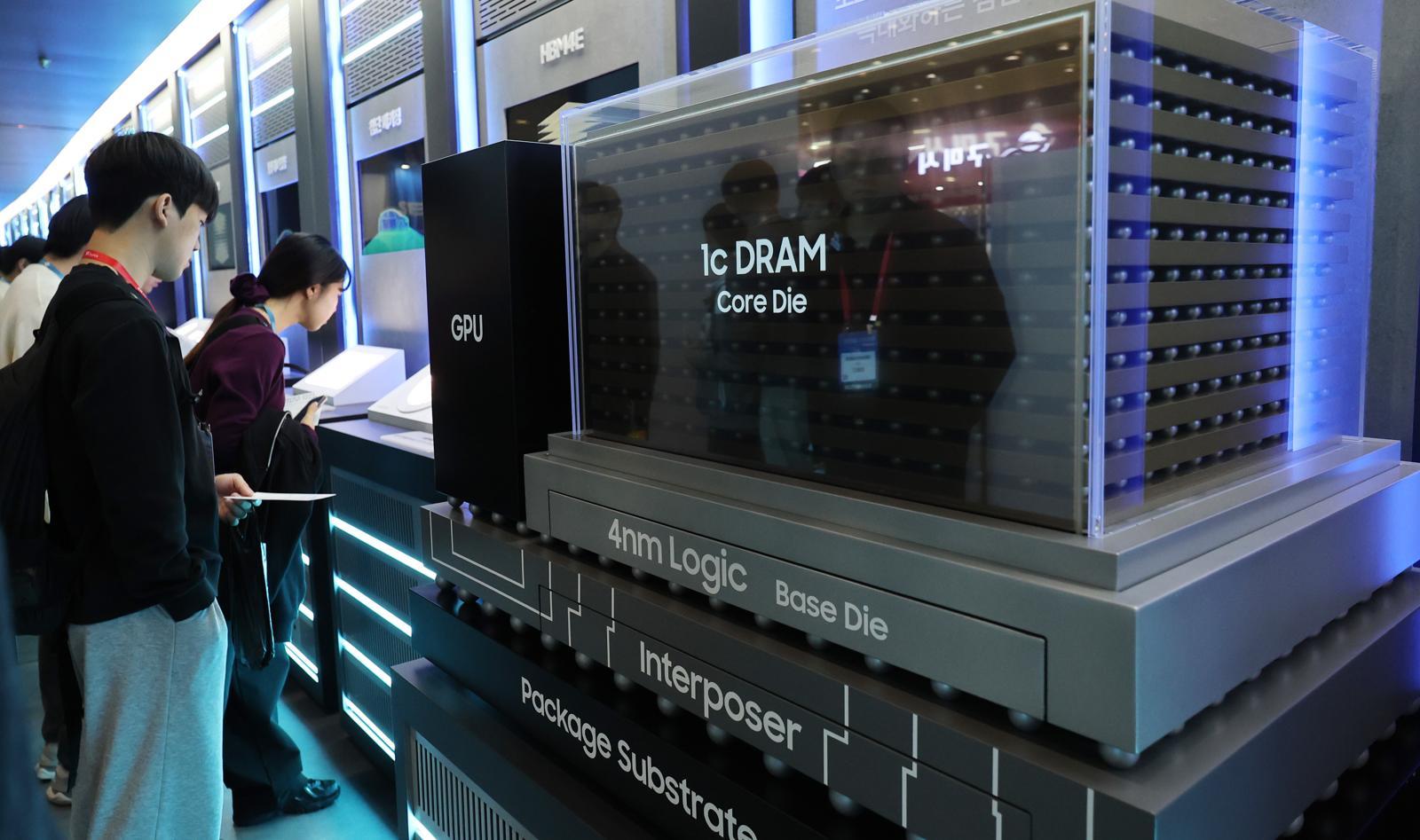
High-bandwidth memory is where the AI war is fought right now. Every generation of large language model demands more memory bandwidth, and HBM — the stacked DRAM that sits directly beside AI training chips — is the bottleneck that determines how fast those models run. Samsung and SK Hynix have jumped to the front of the seventh generation, both showing HBM4E samples at SEDEX. Samsung shipped its 12-layer sample to a customer in May, while SK Hynix says it has completed its own sample run and is targeting volume production next year.
The stakes are enormous. Analysts estimate that by 2030 the total compute capacity of AI infrastructure will be roughly twenty times what it is today, according to SK Hynix’s own development head, Ahn Hyun. But the problem is not just raw compute. As AI models get deeper and more complex, the cost of moving data between memory layers — HBM, regular DRAM, and solid-state drives — creates new power and performance bottlenecks that cannot be solved by making chips faster alone.
The Stacking Strategy: A Bet on 3D
Both Korean companies are betting their survival on a single architectural move: putting the memory directly on top of the processor instead of next to it. Samsung called the approach zHBM. SK Hynix is pursuing a parallel concept it is partnering with Sandisk to standardize, along with a new category of memory called high-bandwidth flash, or HBF. The idea is to use HBM-style 3D stacking and ultra-fast data transfer techniques on NAND flash, targeting a product that delivers roughly half the bandwidth of the current HBM generation but ten times the capacity.
Ahn said the formal HBF standard is expected to drop in January, which would lock in a competitive moat for any company that helped write the rules. Samsung also showed a multi-layer NAND stack called zNAND-O at the show, designed to pull AI data faster for smartphones and other edge devices.
The logic is sound, but the execution is the hard part. Stacking memory on top of logic dies requires precision engineering at the intersection of two very different manufacturing processes. That is exactly where China’s catch-up has stalled — and where Elon Musk publicly mocked it. Posting on X, Musk warned that developing stacked structures that can maintain thermal stability in logic semiconductors is “not easy,” implying CXMT’s path to advanced HBM would be significantly harder than its path to commodity DRAM.
Musk was more blunt about pricing. He complained that Micron’s upcoming memory prices were reasonable while “other vendors” were charging absurd amounts — an unmistakable dig at the Korean firms without naming them. “Today’s customers will not forget this,” he added. The remark signals a growing fracture between the AI chip buyers who depend on Korean memory and the buyers who are looking for leverage to force prices down.
Who Wins, Who Loses
CXMT is the clear disruptor here. Even if it lags Samsung and SK Hynix by one or two generations on the most advanced HBM, a credible DRAM alternative at the 4F² node changes the economics for everyone. Chinese AI companies like Baidu, ByteDance, and Alibaba, which have been forced to rely on Samsung and SK Hynix for their memory needs, suddenly have a domestic fallback. That fallback may not be the fastest, but it reduces the geopolitical risk that has haunted every major AI infrastructure build in the past three years.
For Samsung and SK Hynix, the loss is not immediate revenue but pricing power. HBM has been one of the few bright spots in an otherwise brutal memory market. If CXMT can capture even a fraction of the Chinese demand that currently flows to Korea, the premium on HBM4E will soften — and every gigabyte of margin loss compounds when you are running a capital-intensive industry at the edge of physical possibility.
The bigger loser may be the United States, which has spent billions trying to prevent China from achieving semiconductor self-sufficiency. CXMT’s 4F² advance proves that export controls and equipment bans have slowed, but not stopped, the追赶 — the pursuit — of leading-edge memory. American policymakers will view the SEDEX announcements with considerably less comfort than Korean officials likely did.
What Happens Next
The next six months will determine the shape of the AI memory market through 2027. Samsung and SK Hynix are both racing to convert HBM4E samples into volume production. CXMT is racing to validate its 4F² DRAM in server designs. And American customers are racing to place orders before any of the above collapses their negotiating position.
The HBF standardization effort, led by SK Hynix and Sandisk, could become the quiet hinge. If it lands in January as promised, it may define a new memory tier that sits between HBM and conventional NAND — one that is cheap enough for mass deployment but fast enough for edge AI. Samsung’s competing approaches suggest it will not cede that space quietly.
Meanwhile, CXMT’s credibility keeps growing. It does not need to beat Samsung on HBM to change the game. It only needs to make Chinese AI builders feel confident enough to diversify their memory sourcing away from Korea, and the entire supply chain recalibrates around a new center of gravity.
The race is no longer about who can build the fastest chip. It is about who can build enough of them, at a price their customers will accept, before the politics overtake the physics.