South Korea's Hormuz Tightrope: Why Paris Talks Matter More Than Officials Admit
South Korea and France held only preliminary discussions on Hormuz Strait deployment, yet the military agreements signed alongside those talks quietly restructure Seoul's defense architecture for Middle East operations. The real question is what that architecture enables next.
The Bluff That Isn’t a Bluff
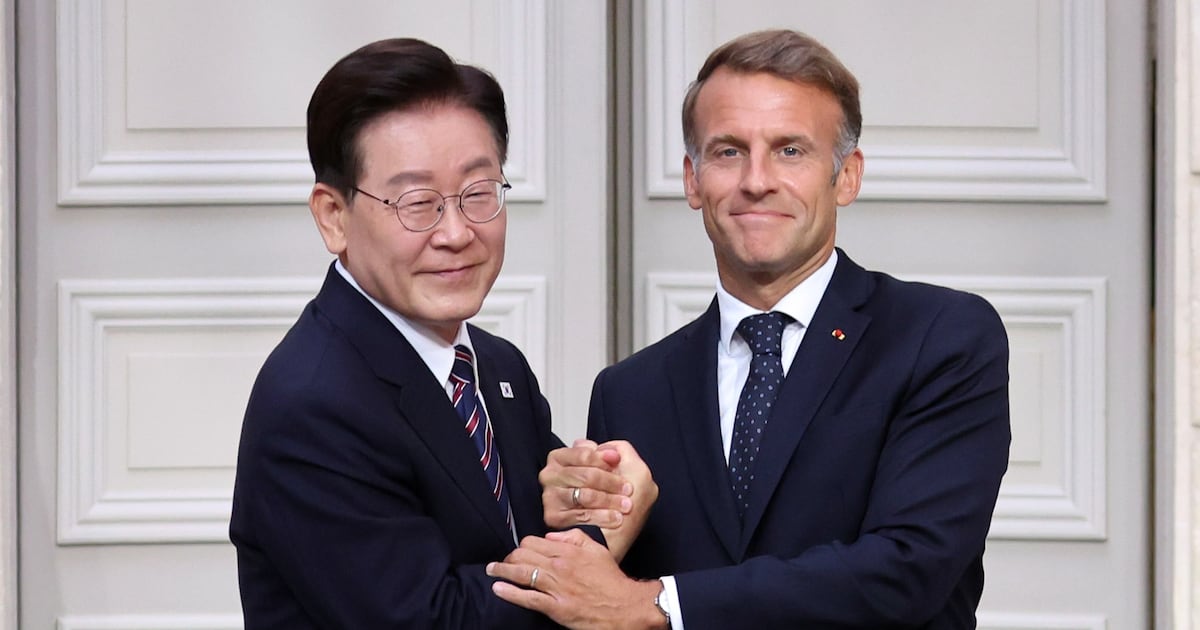
South Korea’s government insists nothing has been decided about sending troops to the Hormuz Strait. French officials say the same. At the September 8 summit in Paris, President Lee Jae-myung and Emmanuel Macron exchanged views at an “original principle level” — a diplomatic phrase that means they discussed the idea without committing to anything concrete. The Blue House repeated this line three times in a single briefing.
But the agreements signed that same day tell a different story. A revised Military Information Protection Agreement and a Mutual Logistics Support Agreement were finalized, both of which would be functionally necessary for any multinational force operation in the Strait of Hormuz. Whether Seoul admits it or not, it has just laid the plumbing for a deployment it claims hasn’t been planned.
What France Actually Wants
France and the United Kingdom have been pushing for an international maritime security coalition in the Hormuz Strait since the regional tensions escalated. The proposal is straightforward in concept: a multinational presence that guarantees freedom of navigation through the world’s most critical oil chokepoint. In practice, it requires partners with ships, satellites, and legal frameworks for operating alongside European forces.
South Korea has both the naval capability and the strategic incentive to participate. The Strait carries roughly a fifth of global oil shipments. Any disruption sends shockwaves through East Asian economies that depend on Middle Eastern energy — including South Korea, which imports over 90 percent of its crude through that passage. Seoul’s interest isn’t ideological; it’s existential in economic terms.
France recognized this. The negotiations in Paris weren’t about extracting a deployment commitment — they were about making sure South Korea would have the legal and operational infrastructure ready when the political moment arrived.
Iran Is Watching, and It Dislikes What It Sees
Moon Seong-rak, the National Security Office chief, confirmed that Iranian officials have already raised the issue through diplomatic channels after Korean media reported on the defense talks. Seoul’s response was characteristically vague: everything remains under review, nothing is decided. Iran accepted no satisfaction from that answer.
This is the core constraint on South Korea’s calculus. Any visible movement toward a multinational Hormuz force risks provoking Iranian retaliation against Korean assets in the region — commercial shipping, energy infrastructure, or citizens. Seoul has navigated this tension carefully for decades, maintaining trade ties with Tehran while deepening security cooperation with Western powers. The Hormuz question forces that balancing act into the open.
The Agreements Are the Story
Let’s look at what was actually signed. The revised Military Information Protection Agreement allows South Korea and France to exchange classified defense intelligence at a higher classification level than before. The Mutual Logistics Support Agreement enables each country’s forces to access ports, airports, and supply chains in the other’s territory during operations.
On their own, these are incremental improvements to an already close alliance. Combined, they form the operational skeleton of a joint deployment scenario. Neither agreement is explicitly about Hormuz. Both would be irrelevant without a specific mission requiring them. That coincidence is not accidental.
Moon Seong-rak insisted the agreements were long-prepared issues unrelated to the current Hormuz situation. That may be technically true — the negotiations likely started months or years ago. But the timing of their completion, simultaneous with active discussions about a French-British-led maritime coalition, gives them immediate strategic relevance. South Korea is building the door while discussing whether to walk through it.
The Nuclear Subplot
The Paris summit also produced an agreement to launch a high-level civilian nuclear dialogue. This deserves attention beyond its energy policy framing. South Korea and France are competitors in nuclear export markets — both sell reactors to the same Middle Eastern and Southeast Asian buyers. Yet the two governments acknowledged that cooperation outweighs competition in certain domains.
Nuclear energy cooperation with France includes technology sharing, fuel cycle arrangements, and potentially collaboration on advanced reactor designs. For South Korea, it diversifies a portfolio currently dominated by American and Russian partnerships. For France, it opens a major Asian market. But there’s a third dimension: nuclear expertise and infrastructure have dual-use implications that matter for any power projecting capability into the Middle East.
Who Wins, Who Loses
If South Korea joins a Hormuz coalition, it gains: enhanced standing as a “global pivotal state” — a label President Lee has actively pursued; deeper integration with European security architectures; and leverage in negotiations with the United States, which has long wanted Seoul to share more burden in Middle East security.
It loses: the trust of Iran, potentially irreversible; domestic political opposition from progressives and pacifist voters who view overseas deployment as risking unnecessary entanglement; and economic ties with Middle Eastern countries that side with Tehran.
France wins either way. If South Korea deploys, France gains a capable naval partner with modern assets and a stake in the outcome. If South Korea stays cautious, France still walks away with upgraded bilateral frameworks and a demonstration that Seoul is willing to engage substantively even without crossing the deployment threshold.
Iran loses either way. A South Korean naval presence in the Strait, even without combat troops, shifts the balance. The mere prospect of it is enough to provoke diplomatic protests and behind-the-scenes pressure — which is exactly what Tehran has already begun.
What Happens Next
South Korea’s strategy of strategic ambiguity — discussing seriously without deciding — will not hold forever. The defense agreements are now in place. The diplomatic channels are open. The question is no longer whether Seoul participates in some form but what form that participation takes and when.
Possible scenarios range from logistical support and mine clearance contributions to full naval deployment. Each carries different risk profiles and different levels of Iranian anger. The Blue House is buying time, but time is a commodity Iran understands poorly and France is slowly running out of patience on.
The next indicator to watch is not another summit statement but the composition of any South Korean defense survey team dispatched to the region. When those names and ship assignments become public, the ambiguity ends.
Until then, Seoul walks a tightrope with one hand on Paris and the other braced against Tehran — and the agreements signed in France ensure that if the rope breaks, there’s infrastructure waiting on both sides.