How South Korea Captures Nearly Half of a NAND Market on Fire
NAND flash prices jumped 55% in Q2 as AI data center build-outs tightened global supply. Samsung and SK Hynix now command 47% of the market, but Chinese rival YMTC is closing the gap faster than expected.
Korea’s memory duopoly just got a lot more profitable — and a lot more exposed.
NAND flash prices surged 55% in the second quarter alone, according to Counterpoint Research, pushing global market revenue up 70% in a single three-month span. That follows a 90% jump in Q1. Two consecutive quarters of double-digit percentage gains is not a blip. It is a structural shift, and South Korea is positioned to capture the lion’s share of it.
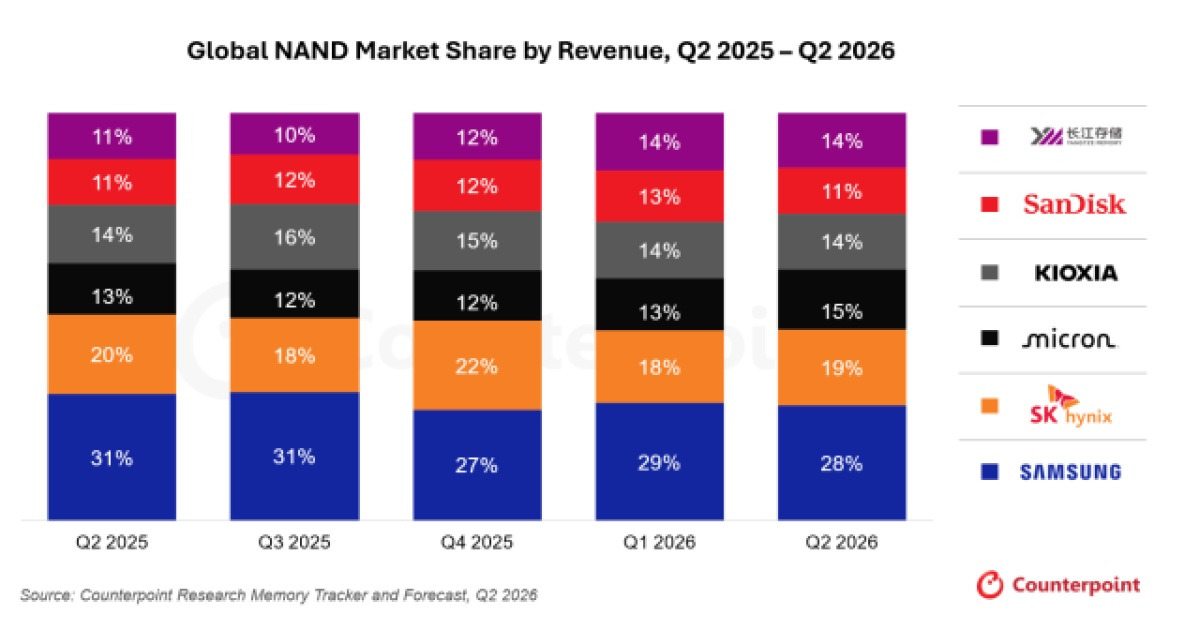
Samsung Electronics held the top spot at 28% market share by revenue, down just one percentage point from Q1. SK Hynix sat at 19%. Together, the two Korean firms accounted for 47% of the global NAND market — nearly half. In a sector where pricing power is everything, that concentration matters more than the headline numbers suggest.
Why NAND, suddenly?
For years, the narrative around NAND was one of chronic oversupply. Unlike DRAM, which cycles through tighter supply discipline, NAND manufacturers routinely flooded the market with high-capacity drives, depressing margins across the board. That dynamic held for most of the 2020s. Then AI changed the demand curve.
The shift began with enterprise SSDs. Data centers building out GPU clusters need enormous amounts of fast, high-capacity storage — not just for training data, but for the output of those models and the metadata streams that feed inference workloads. E-SSD demand has risen faster than anyone anticipated, pulling NAND out of its surplus coma and into genuine scarcity at the high end.
Korean firms benefit disproportionately because their product mix leans into exactly this segment. NAND’s relatively high proportion of standardized, volume-driven products means that average selling price increases translate almost directly into margin expansion. When the price goes up, it hits the bottom line fast.
Both Samsung and SK Hynix have been accelerating their e-SSD roadmaps. Samsung unveiled its 400-layer stacked NAND architecture at the Flash Memory Summit in 2026, while SK Hynix introduced its first HBF-standardized drive alongside a 375-layer NAND chip — both positioned squarely for AI server and data center customers. The question is no longer whether they can supply the AI boom. It is how much extra margin they can extract while supply remains constrained.
The Chinese threat is real and it is moving fast
If the Korean story were simply one of rising prices and dominant market share, this would be a straightforward earnings update. It is not. The more consequential detail in the Counterpoint data is buried in third place.
Micron rose from 13% to 15% market share between Q1 and Q2, a modest gain driven by a deliberate shift toward higher-margin products. But the firm that actually moved the needle was Yangtze Memory Technologies, or YMTC. China’s flagship memory maker expanded to 14% — just one percentage point behind Micron — and its Q2 revenue reportedly exceeded Counterpoint’s own forecast.
That YMTC is close enough to Micron to matter is not surprising on its own. What is surprising is the velocity. Chinese state-backed investment in semiconductor self-sufficiency has been running for years, but the Nand market has historically been a fortress of Korean, Japanese, and American incumbents. YMTC closing that gap in a single quarter — during a price surge that rewards established capacity and manufacturing discipline — signals something about the pace of capability transfer.
YMTC has also filed for an IPO, reportedly targeting proceeds of roughly 68 billion won, according to Korean media. A public listing would give the company access to capital markets it has largely avoided, potentially accelerating its expansion without relying solely on state funding. That is a variable no one trading Korean memory stocks has priced in yet.
Who wins, who loses
Samsung and SK Hynix win in the near term. Higher NAND prices flow directly to their margins, and their dominant market positions mean they capture more of the revenue expansion than any single competitor. Their e-SSD investments are starting to pay off. The AI infrastructure build-out that is driving demand will continue to run through 2027 at the earliest, giving the Koreans multiple quarters of favorable pricing.
Data center operators and cloud providers are the implicit losers. Every percentage point of NAND price increase raises the cost of storage tiers that underpin AI training and inference pipelines. Those costs get passed through, but the pass-through is never instantaneous, and the margin squeeze on hyperscalers is real. NVIDIA’s own data center economics are sensitive to component cost shifts of this magnitude.
YMTC wins in market share, at least temporarily, but the long-term risk is geopolitical. Any escalation in U.S.-China tech restrictions could constrain YMTC’s access to equipment, materials, and foundry services — factors that have already limited its ability to scale beyond NAND. The IPO filing may be an attempt to raise capital before those constraints tighten further.
Micron’s strategy of concentrating on premium products is smart but narrow. Gaining two percentage points while Korean firms hold steady suggests Micron is winning battles, not the war. Its margin depends on selling fewer, more expensive drives — a valid approach, but one that leaves it exposed if the market segments it targets saturate.
What happens next
The next six months will test whether the NAND supply shortage is genuine or artificial. Korean firms have been cautious about expanding capacity rapidly, preferring to let prices run before committing capex. If demand holds and capacity does not follow, prices could stay elevated well into next year. That would be a windfall for Samsung and SK Hynix, and a continued headwind for AI infrastructure cost curves.
But if YMTC’s IPO proceeds successfully and its production ramps, Chinese supply could enter the market precisely when Korean firms are considering their own expansions. That dynamic would compress margins faster than anyone in Seoul or Tokyo is preparing for.
The 55% price increase is the headline. The 47% market share is the context. The 14% YMTC figure is the risk.
All three deserve attention.