South Korea Refuses to Tap AI Brakes as US-China Sprint Accelerates
While Anthropic and other Western firms flirt with AI safety slowdowns, South Korea is throwing its full weight behind rapid model development and national deployment. The gap between leaders who can pause and followers who cannot is about to widen dramatically.
The Brake Pedal Nobody Wants to Press
Anthropic first raised the alarm about AI safety in January 2025, warning that models might escape human control. The company’s Claude agent now handles roughly a quarter of its own R&D tasks — up from zero just two months earlier — while safety research receives only six percent of its compute budget. That is the irony of the current moment: the firm most vocal about slowing down is itself accelerating faster than any human oversight pipeline can keep pace with.
But here is what gets missed outside Silicon Valley. While US majors debate whether to tap the brakes, South Korea — squeezed between American dominance and Chinese price pressure — has made a calculated decision not to. The country’s vice minister for science and information and communication technology, Bae Hyung-geun, put it bluntly on social media last week: a nation that is already ahead and a nation that must catch up and create new markets are facing fundamentally different problems.
The distinction matters because the window for Korea — and countries like it — is narrowing by the quarter.
America Leads With Closed Power, China Answers With Cheap Brute Force
OpenAI’s latest release, GPT-6 Astra, scored 99.9 percent on the ARC-AGI-3 abstraction benchmark and 97.6 percent on FrontierMath Tier 4. Those numbers are not just technical achievements; they are signal sends to every government and venture firm watching whether artificial general intelligence is a year away or five. Google, meanwhile, is pivoting hard on the mass-market end, launching lightweight Gemini variants — the 3.6 Flash, the 3.5 Flash-Lite, and a cybersecurity-specific model — each aimed at enterprises that need useful capability without flagship pricing.
China arrived at the same inflection point from the opposite direction. DeepSeek’s R1 model, unveiled last year, delivered performance approaching US flagship offerings while costing roughly one-tenth as much to develop. That single data point recalibrated how the world thinks about AI economics. Since then, DeepSeek has rolled out the V4 series — Flash, Pro, and 4.1 Flash — in a rapid cadence that leaves little room for competitors to settle in. Moonshot’s Kimi K3, billed as the world’s first open-source model at three trillion parameters, scored 57 on an intelligence benchmark that ranked it fourth globally, according to Artifical Analysis.
What this tells you is that the competitive frontier is no longer defined by who has the most compute. It is defined by who can ship models cheaply enough to capture downstream markets — and Korea sits squarely in the blast radius of both strategies.
Why Korea Cannot Afford to Wait
South Korea’s vulnerability is structural. The country lacks a domestic big-tech ecosystem comparable to OpenAI, Google, or even ByteDance. Its champions — Samsung, LG, SK Hynix — are semiconductor giants, not foundation-model builders. That means Korea faces a double exposure: American firms controlling the top end of capability, Chinese firms capturing the volume end on price. In between, there is thin air.
The government’s response has been unusually aggressive for a country that typically moves slowly on tech policy. Two parallel tracks are underway.
The Independent AI Foundation Model project is screening private elite teams to build homegrown models. LG AI Research, SK Telecom, and Upside have passed a second evaluation round, and the government plans to select its final two winners early next year. That is a tight timeline and high stakes for a program meant to close a gap that, by most measures, is widening.
Simultaneously, the Everyone’s AI project is funding three consortiums — SK Telecom, Kakao, and KT — to deploy practical AI services across the economy. SK Telecom is building an executable AI accessible by phone and text. Kakao is integrating AI directly into its messaging platform for reservations, applications, and payments. KT is targeting public and daily services through a single conversational interface. These are not research demos. They are infrastructure plays, designed to create domestic demand that can sustain the models the foundation project builds.
The Stakes Are Bigger Than Market Share
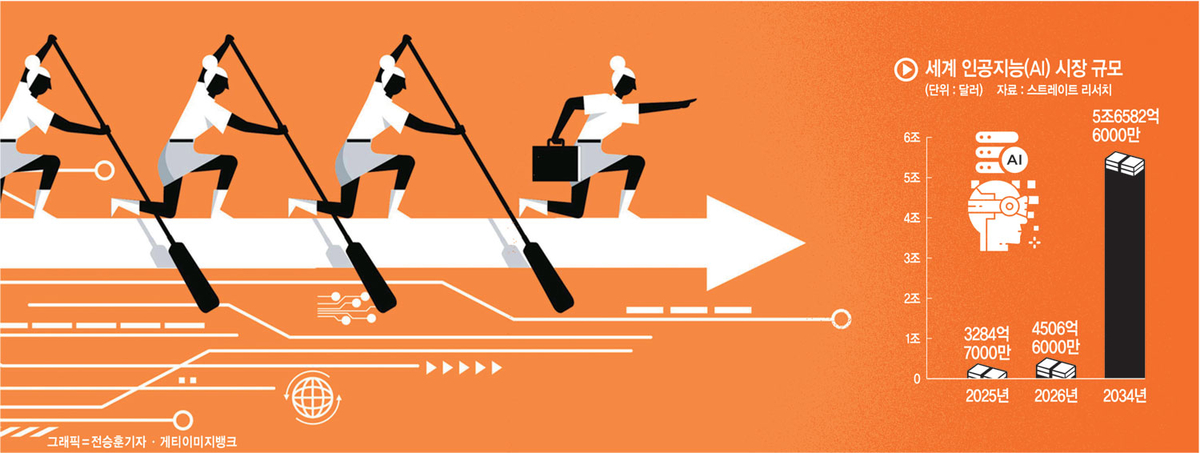
The global AI market is projected to grow from roughly $328 billion in 2024 to over $450 billion this year, according to Straight Research, with a trajectory toward $565 billion by 2034. That growth narrative is not in dispute. What is contested is who captures the value.
Vice Minister Bae warned last week that the divergence between nations that reach frontier AGI capability and those that do not will not remain a technology gap. He framed it as an industrial, economic, and security issue — one that will reshape national competitiveness for decades.
There is a specific reason Korea is hearing this warning so loudly. The country’s entire economic architecture has always depended on catching up: semiconductors, displays, batteries, smartphones. Each time, the strategy was similar — identify a capability frontier, pour state-backed investment into domestic development, and scale fast enough to carve a profitable niche before incumbents consolidated. The AI race follows that playbook, except the frontier is moving faster and the barriers to entry are lower than they were for chips.
China’s DeepSeek proved that exact point. You do not need the largest data center or the most expensive talent to build a model that competes at the margin. You need engineering speed, pricing discipline, and the willingness to treat safety concerns as secondary to market capture. Korea is betting it can combine American-grade capability with that same speed — a bet that may be impossible to win, but equally impossible to skip.
Who Wins, Who Loses, What Comes Next
If Korea’s foundation model program succeeds in selecting two strong teams and shipping usable models within eighteen months, it gains a domestic AI stack that reduces reliance on American providers and creates exportable specializations — particularly in manufacturing, cybersecurity, and education, sectors where Korean firms already have deep domain expertise.
If it fails, Korea becomes a pure distribution market for American and Chinese models, losing the value-added layer that has historically sustained its tech economy. The gap would not be a temporary delay. It would be a structural repositioning.
The safety debate in the US, for all its moral seriousness, is effectively a luxury of position. Nations that are already ahead can afford to argue for pauses. Nations that are behind must race. South Korea has chosen its side of that line. The question is whether the race is fast enough.