Toyota's 400,000 Humanoid Robots Are a Signal Japan Isn't Backing Down
Toyota is committing to deploy 400,000 self-developed humanoid robots called Elli across its aging factory network starting in 2028, backed by annual spending of 1 trillion yen. The move is Japan's most concrete answer yet to the U.S.-China race over physical AI.
The Number That Should Worry Boston Dynamics’ Investors
Toyota announced it will deploy 400,000 humanoid robots across its factory operations. Not prototypes. Not pilot lines. Four hundred thousand units, starting in 2028, funded at an annual rate of 1 trillion yen across Toyota and the broader group.
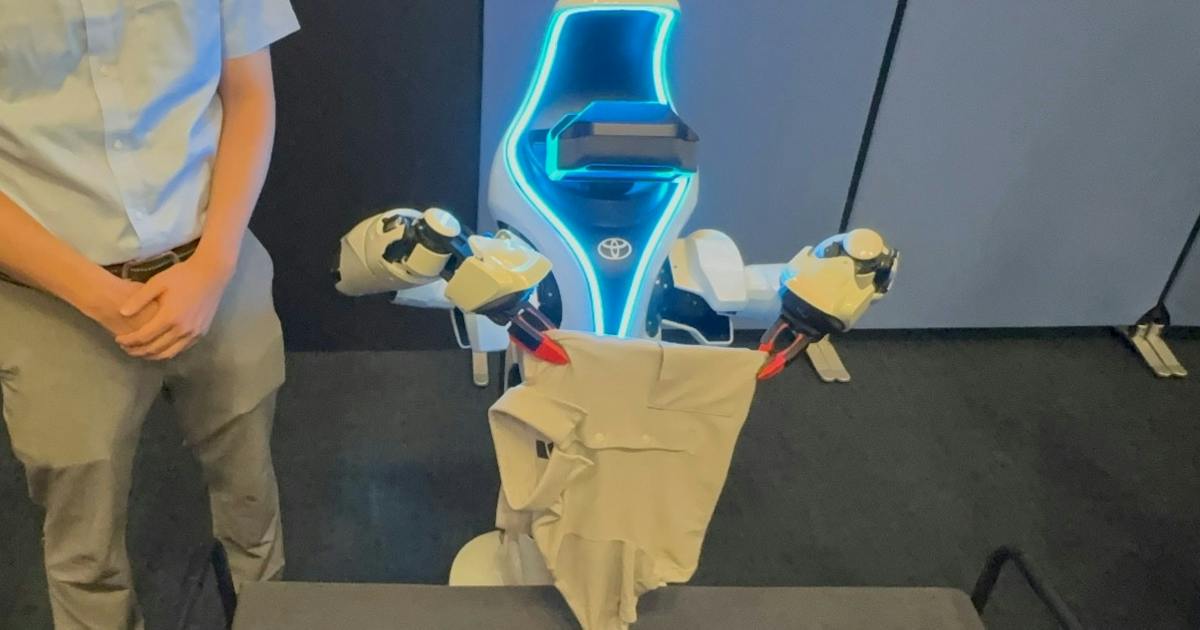
The robot is called Elli. It has two fingers. It weighs 50 kilograms. It runs on battery or a power cord. It moves on wheels, not legs.
None of that is accidental.
What Elli Actually Is
Elli isn’t a humanoid in the theatrical sense. No bipedal gait. No anthropomorphic face. Two fingers on a single hand. A wheeled base. The design reads as pragmatic to the point of provocation — this is a robot built for one job in one environment, not a general-purpose automaton.
That precision is the story.
Toyota is rolling Elli out alongside the renovation and replacement of aging factory buildings across the group. The robots won’t replace humans; they will work alongside them, handling tasks that don’t require the dexterity of a ten-fingered hand but do benefit from consistent, repeatable force and motion in a constrained workspace. Think heavy lifting, part positioning, repeated assembly motions — the kind of work that wears down human bodies over decades.
This is Toyota’s version of the cobot argument, scaled to an industrial empire. The robot is small, simple, and purpose-built. The deployment is massive.
The 1 Trillion Yen Per Year
The 1 trillion yen annual figure is significant because it places Toyota’s robotics commitment in the same fiscal universe as its R&D budget for entire vehicle platforms. That’s not a side project. That’s infrastructure investment at the level of a new engine line or a fresh battery factory.
What 1 trillion yen buys in robotics terms is still unclear — we don’t have unit costs, production timelines, or per-robot pricing from Toyota. But the scale of annual spend signals that the company expects Elli to be a recurring capital line item, not a one-off pilot. That changes how anyone tracking industrial robotics should read this.
Why Japan Is Betting on Physical AI Now
The timing matters. This announcement sits inside a broader push across Japanese industry to close a gap that has been widening for years. The United States is pouring billions into foundation models for physical AI. China is building data collection apparatuses at state scale. Japan has been quieter, but the moves are real.
At the center of Japan’s strategy is YUBI — a data-collection glove that records human hand movements during actual factory work and converts them into training data for robot manipulation. The logic is straightforward: if you want a robot hand that can do what a human hand can do, you need high-quality movement data from human hands doing those same tasks. YUBI collects exactly that.
A contributor to Nikkei noted that Japan’s path to winning in physical AI may run through mass-produced, high-quality datasets rather than raw compute power. The United States is accumulating data at scale — one company reportedly collects over 10,000 hours per week. China is institutionalizing data governance. Japan’s play is different: build open data infrastructure, feed it with real factory-floor movement, and let the robots learn from what skilled workers already know how to do.
Who Wins. Who Loses.
Toyota wins if Elli deployment stays on schedule and the robots prove reliable in live factory conditions. The company gains a scalable automation tool that doesn’t require rebuilding every factory from scratch — it fits into the renovation cycle that was already planned. That’s a cost advantage no startup can match.
Japan wins if YUBI-style data collection becomes the standard for physical AI training data. An open dataset built from real Japanese manufacturing work could become a competitive moat, the way Toyota Production System once was. The world doesn’t yet have a dominant standard for robot manipulation training data. Whoever establishes it first shapes the next decade of factory automation.
U.S. and Chinese robotics firms lose ground if Elli deployment demonstrates that purpose-built, low-complexity humanoids can outperform general-purpose ones in defined industrial settings. The narrative that humanoid robots must look and move like humans to be useful is losing credibility — Elli is proof of that.
Toyota’s suppliers and competitors lose if the 1 trillion yen annual commitment crowds out investment elsewhere in the robotics ecosystem. Capital follows conviction. When the world’s largest automaker commits that much, other players recalibrate. Some will follow. Some will fold.
What Comes Next
The first question is whether Toyota can actually produce 400,000 Elli units at viable cost. Four hundred thousand is not a prototype run. It’s a production target that requires supply chains, manufacturing lines, and quality control calibrated for consumer-grade reliability at industrial scale.
The second question is whether Elli’s two-finger design limits its usefulness to a narrow set of tasks. Two fingers is enough for gripping and holding. It isn’t enough for fine manipulation — threading a wire, turning a small bolt, handling fragile components. If Elli is confined to heavy, repetitive work, the 400,000-unit deployment makes sense as a targeted replacement for the most physically demanding jobs on the line. If Toyota expects Elli to handle broader tasks, the two-finger constraint becomes a liability.
The third question is the one nobody outside Japan is asking yet: what happens when Elli data feeds into global physical AI models? If YUBI-collected movement data trains robots beyond Toyota’s factories — which is the stated aim of building an open data platform — then Elli isn’t just a Toyota product. It becomes part of the training substrate for an entire generation of industrial robots worldwide.
That would make Toyota less a robot manufacturer and more a data infrastructure company. The distinction matters more than it sounds.
The Bigger Picture
Japan’s industrial decline has been the accepted narrative for thirty years. Declining birthrate. Aging workforce. Factories that look like museums. The story wrote itself.
Elli and the 400,000-unit deployment are a different story. It’s not dramatic. It’s not a robot that walks on two legs and waves at the camera. It’s a wheeled, two-fingered machine that Toyota is quietly installing in factories that were already scheduled for renovation.
The bet is that simplicity at scale beats complexity at pilot volume. The bet is that real factory data beats synthetic training. The bet is that Japan can compete in physical AI without matching U.S. spending or Chinese state coordination — by doing the unglamorous work of collecting, organizing, and deploying data at industrial scale.
Whether that bet pays off depends on whether the robots work, whether the data opens up, and whether the world decides that a two-fingered robot on wheels is enough to change the calculus of factory automation. We won’t know for a few years. The deployment timeline starts in 2028.
The number 400,000 is the hook. The rest is still unfolding.