Trump's 50% Canada Tariff Is a Wake-Up Call for Asian Automakers
Trump's escalation on Canadian autos and steel forces Korean and Japanese automakers to confront a hard truth: USMCA protections are conditional. The question is no longer whether to produce in America, but how fast they can pivot.
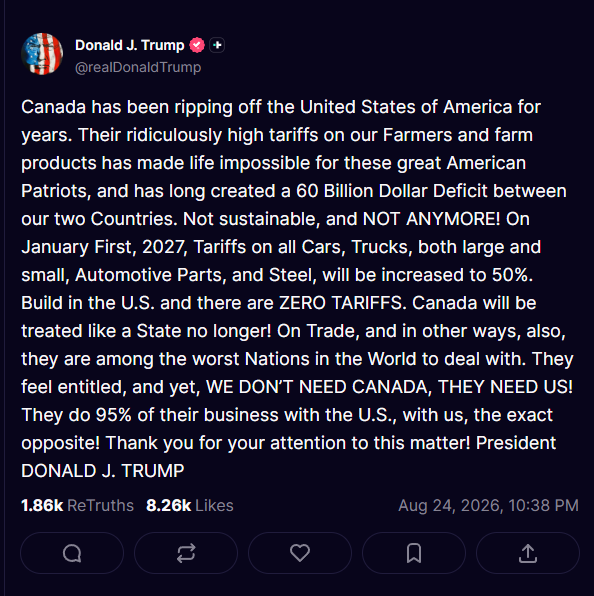
The tariff that rewrites North American auto strategy
Donald Trump’s announcement on August 24 that tariffs on Canadian automobiles, truck parts, and steel will jump to 50% starting January 1, 2027, is not simply a bilateral dispute between Washington and Ottawa. It is a structural signal — and the shockwave is already reaching the factory floors of Hyundai, Kia, Toyota, Honda, and Nissan across the United States.
The mechanism matters. Trump framed the escalation as a response to what he called a $60 billion trade deficit with Canada, calling the relationship unsustainable and declaring that Canada would no longer be treated like another American state. He also left the door open: vehicles made on U.S. soil would face zero tariffs.
That conditional exemption is the detail East Asian automakers are reading between the lines.
Why Canadian content changes everything
The U.S. auto supply chain does not respect national borders — it treats them as friction. Mexico and Canada each contribute heavily to vehicle assembly, parts sourcing, and supplier logistics. A single truck might cross the border five or six times before it rolls off the line. That is the architecture USMCA was designed to lock in, and Trump’s tariff escalation is effectively dismantling one wing of it.
For Korean and Japanese manufacturers, the problem is not abstract. Plants in Ontario and Quebec supply components and subassemblies to U.S. assembly lines in Michigan, Kentucky, Alabama, and Tennessee. When a 50% tariff hits those Canadian-origin inputs, the cost structure of every North American-built vehicle shifts overnight. There is no short-term substitute for the supplier density in South Ontario, where clusters of part makers sit within a hundred miles of assembly plants in the American Midwest and Upper South.
Relocating that supply base takes years, not quarters. That timeline is the constraint everyone in the industry is measuring against.
Consider the specific anatomy of the exposure. Hyundai’s Kentucky plant, which produces the Sonata, Elantra, and NV3500 van, pulls from a network of Tier 1 and Tier 2 suppliers spanning Windsor, Sarnia, and Oakville. Kia’s Georgia facility, the largest auto plant in the Western Hemisphere, sources engine components from Toyota Tsusho’s Canadian operations. Toyota’s Burnstown Parts Centre in Ontario is a critical hub for transmission and engine parts feeding its Cambridge and Georgetown, Ontario plants, which in turn ship finished vehicles and components southward into Indiana and Ohio lines.
A 50% tariff on those inputs does not simply raise costs — it threatens the margin structure that made North American production viable against Korean and Japanese competitors who have historically kept their home-market operations lean. The math is unforgiving. For a vehicle with $8,000 to $12,000 in Canadian-sourced content, a 50% tariff adds $4,000 to $6,000 per unit. At volume, that is not a rounding error. It is an existential line item.
What this means for Hyundai, Kia, Toyota, and others
Hyundai and Kia have been expanding U.S. production capacity aggressively — the Alabama plant, the Georgia facility, and ongoing investments in EV and battery supply chains. Toyota and Honda have deep legacy footprints in the Southeast and Midwest. All of them have relied on integrated North American supply chains that include Canadian sourcing.
The 50% tariff makes that integration expensive. It also makes Trump’s “zero tariffs if you build in America” promise both an incentive and a trap. Incentive, because it rewards domestic assembly. Trap, because the definition of domestic content is negotiable and the political ground beneath it can shift before a plant is even break-grounded.
The real question for Asian automakers is whether Canada remains a reliable node in their supply chain under this new tariff regime — or whether it has become a liability they need to restructure around.
For Hyundai and Kia, the calculation may be simpler than for Toyota or Honda. Both Korean groups have been deliberately decoupling their U.S. production from Canadian dependency, building out U.S.-based supplier partnerships and investing billions in Georgia and Alabama as alternatives. They have been treading toward this moment for years. Their exposure is real but mitigated by choice.
For Toyota, Honda, and Nissan, the posture is different. Their North American operations were designed under NAFTA and early USMCA assumptions that cross-border flow would remain tariff-free. Retooling that architecture now means not just capital expenditure but organizational reorganization — re-certifying suppliers, renegotiating logistics contracts, and recalibrating production schedules that were optimized for just-in-time delivery across a seamlessly integrated continent.
The USMCA dilemma
USMCA was supposed to be the anchored regime that replaced the fragile peace of NAFTA. Instead, Trump’s actions suggest that the agreement is enforceable only as long as the president in Washington decides it is. Canada’s retaliation, announced for early September, targets $20 billion in U.S. exports including steel, dairy, appliances, agricultural machinery, pulp and paper, and electronics. That is not a symbolic response. It is calibrated pain.
What happens next is unclear. Trade wars rarely end with a formal surrender — they fizzle, mutate, or harden into a new normal. But for the automotive sector, the uncertainty itself is the cost. Investment decisions that were made on the assumption of stable cross-border rules now carry a new risk premium.
The nuance that is often missed is that Trump’s tariff on Canadian autos and steel is not isolated from the broader tariff architecture his administration has built or threatened. A blanket 25% tariff on all Mexican imports — also announced — creates a mirrored pressure on the southern flank of North American supply chains. Automakers now face a pincer movement: Canadian content taxed at 50%, Mexican content threatened at 25%. The only escape route is domestic U.S. production, but domestic production cannot scale overnight, and the capital requirements are staggering.
The domino effect
The second-order effects reach beyond autos. Steel tariffs raise the input cost for every manufacturer that uses domestic-rolled or imported steel — from appliance makers to construction equipment. Canadian aluminum, which feeds aerospace and automotive sectors, is also exposed. The ripple moves outward.
For Korean and Japanese automakers, the broader lesson is blunt: geographic proximity to the U.S. market no longer guarantees stable access. Supply chain design must assume that political boundaries can rewrite cost equations faster than capital can be redeployed.
One consequence already visible: U.S. steel prices have surged past $1,000 per ton, driven in part bySection 232 tariffs that predate this escalation. When Canadian steel is added to the restriction list, the shortage deepens. Suppliers who once sourced from Stelco or Dofasco — both major exporters to the U.S. auto sector — will scramble for alternative mills. That scramble translates into delivery delays, which translate into production line stoppages, which translate into missed model-year targets.
Another consequence is less immediate but more strategic: the re-evaluation of Canada as an investment destination. Hyundai’s existing commitments in Ontario — including a $1.5 billion engine plant in Brampton and a transmission facility in Woodstock — are now assets with compounding risk. Will future capital follow? Or will Ottawa’s appeal as a gateway to the U.S. market evaporate, leaving Asian automakers with stranded capacity?
The strategic fork
Asian automakers now face a strategic fork. On one path: accelerate U.S.-based sourcing, absorb the costs of relocation, and accept that the era of frictionless North American integration is over. On the other: lobby aggressively for exemptions, leverage political connections in states where their plants provide jobs, and hope for a negotiated settlement.
Neither path is clean. Lobbying has limits when the executive branch signals that trade is a weapon. And relocation has limits when the supply chain physics do not bend to will.
What is clear is that the firms that treat this as a temporary disruption will be wrong. The firms that treat it as a structural reset will have options. The first group will be reacting to the next announcement. The second group will be preparing for the one after that.
The bottom line
Trump’s 50% tariff on Canadian autos and steel is less a final settlement than a signal flare. It tells suppliers, automakers, and investors that North American trade rules are subject to renegotiation at any moment. The firms that bake that volatility into their strategy now — by accelerating U.S.-based sourcing, compressing lead times, and building flexibility into their North American footprint — will carry the advantage. Those that treat USMCA as immutable will carry the bill when the next tariff announcement drops.
For Korean and Japanese automakers, the moment of truth has arrived. The question is not whether they will adapt. It is whether they will adapt fast enough to avoid being adapted around.