Two Chokepoints, One Shock: Why $100 Oil Is Rewriting Asia's Rules
With Hormuz and the Red Sea simultaneously disrupted and oil above $100, Asia's trade-dependent economies face a policy trap Europe can't escape. Korea's won weakness and capital outflows are the canary — the real question is whether central banks will choose inflation or growth first.
The Map Has Changed
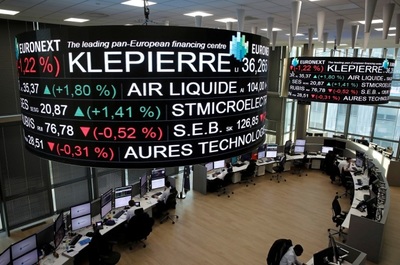
Europe opened lower on September 9 across every major index. The STOXX 600 fell 1.41%. The DAX dropped 1.66%. The CAC 40 slid 1.94%. The moves were sharp but mechanistic — sell-off triggered by headlines from a theater thousands of miles away.
The headlines told the story in real time. Iran’s IRGC launched missiles at U.S. Navy vessels near Oman on September 7, following a similar attack five days earlier. The U.S. responded by sinking five Iranian油 tankers — four near Oman and one near Hormuz island. On September 9, Iran struck a U.S. airbase in Jordan with ballistic missiles and claimed it hit two Aegis destroyers. In the Red Sea, Houthi forces fired drones and missiles at four Saudi cities, targeting airbases and what the source describes as core refining and power infrastructure owned by Aramco. At least 73 people, including women and children, were injured.
Iran also issued warnings to oil tankers approaching Kuwait and Bahrain, ordering crews to abandon ship and withdraw.
Brent crude breached $100 a barrel, rising 3.43% to $101.28 by late afternoon London time. This was the first time since late July that the benchmark cleared the psychological threshold.
Two Wars, One Anatomy
What makes this episode structurally different from previous supply disruptions is the simultaneity. Hormuz and the Red Sea are not parallel routes — they are sequential bottlenecks through which the same cargo must transit. A tanker bound for Europe or Asia from the Gulf does not choose between them. It passes both.
Strait of Hormuz handles roughly 21 million barrels per day of crude and petroleum products — approximately one-fifth of global seaborne oil trade. The Red Sea and Suez corridor carry another significant fraction, including Saudi exports routed through the Yanbu pipeline terminus and refined products from regional refineries.
When one chokepoint is disrupted, shippers reroute. When both are contested at once, there is no reroute. The spare capacity that markets depended on during the 2022–2024 period — idle Iranian capacity, UAE surplus, Kuwaiti flexibility — evaporates under simultaneous pressure. What remains is inventory drawdown and spot-market bidding among desperate buyers.
The European Front Line
UBS’s Kieran Ganesh framed the transmission mechanism plainly: oil higher raises inflation expectations, which raises rate-hike probability, which raises bond yields, which compresses equity valuations. The chain is direct. European markets are the most exposed because the continent imports the vast majority of its energy and has structural deficit in shipping alternatives.
Euro-zone bond yields climbed to multi-year highs ahead of the ECB meeting. Reuters reported that markets are pricing in two additional rate hikes by year-end, with the policy rate reaching 3.1% by late 2027. That is a steep trajectory for an economy that was already hovering near stagnation before this escalation.
The French government signaled it would not repeal the temporary corporate tax surcharge on large companies but would reduce it — a half-measure aimed at preserving revenue while signaling restraint. Finance ministers across the continent are now balancing three incompatible objectives: containing energy-driven inflation, preventing growth from contracting further, and avoiding fiscal deterioration that would weaken their currencies.
Only the energy sector rose — up 0.3% in the STOXX. Everything else sold off.
Korea’s Position
This is where the picture sharpens for Asia. Korea imports over 98% of its energy. The country’s trade balance is exceptionally sensitive to oil price movements because refined petroleum products and LNG constitute major import categories. A sustained $100 environment does not merely raise the cost of production — it shifts the terms of trade against import-dependent Asian economies and toward producers.
The won’s depreciation is not independent of these events. Capital flows out of emerging Asian currencies toward the dollar when energy bills surge and central banks face conflicting mandates. The Bank of Korea is caught between defending the currency and preventing a growth spiral — a position identical to what the RBI faced during the 2022 energy crisis and what Indonesia managed more successfully by letting the rupiah absorb more of the shock.
Korea’s export sector, the engine of growth, faces a dual squeeze: weaker won boosts nominal export revenues in won terms but raises input costs for manufacturers who import intermediate goods and energy. The net effect depends on margins and the degree to which price increases can be passed through to buyers in dollar-denominated contracts. In commodity-intensive sectors — petrochemicals, refined fuels, aluminum — the margin compression is immediate.
The Central Bank Dilemma
Every central bank in the region now faces the same binary: raise rates to defend the currency and tame imported inflation, or hold and accept a weaker won and higher consumer prices.
The ECB’s trajectory toward 3.1% by 2027 implies exactly this choice, made on Europe’s behalf. Korea’s choice will be quieter but no less consequential. A rate hike now would deepen the currency’s weakness temporarily before stabilizing it — a painful sequence for an economy with significant external debt denominated in foreign currency. Holding steady risks a credibility gap that could accelerate capital flight.
Neither option is clean. That is the nature of a supply shock hitting an economy already navigating weak demand and elevated debt.
What Happens Next
The direction of oil prices depends on three variables: whether Hormuz closes entirely, whether Saudi infrastructure damage proves partial or catastrophic, and whether U.S. strategic reserves see coordinated releases. None of these are predictable this week. The second-order effects — currency moves, equity volatility, sovereign spread widening across Asia — are more tractable and already unfolding.
What is clear is that the era of cheap energy as a background condition for Asian growth is over, at least for now. Markets priced that assumption for a decade. The double chokepoint disruption has invalidated it in real time.
European indices may recover on a calm day. Asian currencies will not rebound until the shipping lanes stabilize. The question for policymakers in Seoul, Tokyo, and Singapore is not whether to react — it is whether to react alone or coordinate, and whether coordination is even possible when every capital is simultaneously defending its own perimeter.