The UN Speaks. Russia and Ukraine Keep Bombing Each Other's Energy Grids.
As world leaders gather in New York for the UN General Assembly, Russia and Ukraine escalated their aerial war with strikes targeting energy and port infrastructure. The symbolism is stark — diplomacy on one floor, destruction on the other — and the energy market fallout may be the most consequential unintended side effect.
The Diplomatic Theater vs. The Sky Over Eastern Europe
While cameras flashed in New York as world leaders filed into the United Nations General Assembly this week, the skies above Ukraine and western Russia told a different story entirely.
Russia’s defense ministry confirmed on September 22 that it carried out large-scale strikes across four Ukrainian regions — Kyiv, Dnipro, Poltava, and Odesa — using precision ground, sea, and air-launched weapons. The targets were not limited to military installations. Port infrastructure, naval vessels, military-industrial complexes, and fuel and energy facilities were all struck, according to the Russian statement.
Ukraine’s air force reported that Russia launched 212 drones and four cruise missiles during the operation, along with Onyx anti-ship missiles and ballistic missiles — a significant escalation in the mix of ordnance deployed in a single coordinated attack.
Russia’s own air defense forces claimed they intercepted 297 drones overnight across multiple regions. Meanwhile, Ukrainian drones were reported hitting civilian targets in Russia’s Samara region, including private homes and vehicles, according to regional governor Vyacheslav Fedorishchev.
The damage inside Ukraine was immediate. Three people were killed and six injured in the Dnipro region alone. In Chernihiv Oblast to the north, a Russian strike on an energy facility triggered power outages affecting approximately 100,000 consumers.
The timing could not have been more pointed. The UNGA’s high-level week has just begun, with U.S. President Donald Trump pressing for a ceasefire deal. Yet Moscow and Kyiv appeared to be sending a message simultaneously: the bombs will keep falling whether diplomats are talking or not.
Who Wins, Who Loses
The immediate loser is Ukraine’s energy grid — already a recurring target in this war, but this wave of strikes suggests Russia is refining a strategy of systematic energy infrastructure degradation. The Chernihiv outages affecting 100,000 people came weeks into autumn, when heating demand begins to climb. That is not accidental.
The port strikes targeting Odesa and the surrounding region carry a longer-game dimension. Odesa remains Ukraine’s primary Black Sea export route for grain and other critical goods. Disrupting port infrastructure and naval vessels is a lever Russia has used before, and one that gains potency as global grain markets grow sensitive to supply interruptions.
On the Russian side, hitting civilian targets in Samara Oblast — deep in the Russian interior, hundreds of kilometers from the front lines — demonstrates Ukraine’s growing long-range drone capability. It is also a psychological signal: the war is no longer confined to eastern Ukraine.
For the West, the symbolism of strikes erupting during the UNGA is a reminder that diplomatic timelines and battlefield realities operate on completely different schedules. Trump’s ceasefire pressure has not slowed either side. If anything, both appear to be racing to improve their positions before any potential negotiations.
The Energy Market Layer Western Outlets Miss
Here is where the story gets economically interesting, and where much of the English-language coverage is underplaying the stakes.
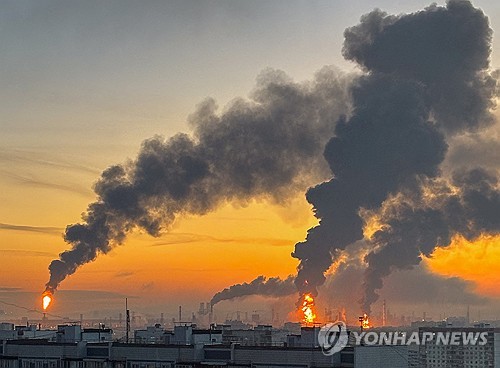
Russia’s stated targeting of Ukrainian fuel and energy facilities is one thing. But the broader war against energy infrastructure — Ukrainian ports, Russian refineries, supply routes — has compounding effects on global oil markets that deserve closer attention. Reuters imagery accompanying the Yonhap report showed smoke billowing from a Moscow oil refinery, a visual reminder that Russia’s own energy export infrastructure is now a legitimate battlefield target.
When refineries burn, crude prices react. When Ukrainian grain ports face repeated disruption, food prices feel the pressure. And when both happen during a week of heightened geopolitical tension, markets price in risk premium.
This is where the strategic calculus extends beyond Eastern Europe. Any escalation that threatens Russia’s ability to export oil — or Ukraine’s ability to export grain — does not stay regional. It moves through the same supply chains that connect Houston, Rotterdam, Mumbai, and Shanghai. The Hormuz strait has dominated energy headlines recently due to Iran-related tensions, but the Black Sea corridor and Russian refinery output deserve equal attention. Disruptions in either theater feed the same global pricing mechanism.
The International Energy Agency has warned repeatedly that the war has already reshaped European energy flows, redirecting Russian oil away from the continent and toward India and China at discounted prices. Further strikes on energy infrastructure could tighten an already constrained market heading into winter.
What Happens Next
Several trajectories are plausible, and none depend on what happens in New York.
Russia is likely to continue its pattern of escalating strikes on energy and port infrastructure as winter approaches, testing whether Western arms deliveries can keep pace with Ukrainian air defense needs. The 297 drones intercepted overnight is a number that suggests Russia’s air defense is holding — for now — but drone fleets are cheap and Ukraine’s suppliers are expanding production.
Ukraine will likely intensify its deep-strike drone campaigns against Russian refineries and oil terminals, exactly the kind of asymmetric response that makes this war economically costly for both sides. The Samara hits were a preview. More will follow.
The diplomatic track faces a brutal test. Ceasefire proposals lose credibility when both sides are busy destroying each other’s energy systems. The UNGA photo opportunities will continue, but the actual leverage — if any — depends on whether Washington, Brussels, or Ankara can offer concessions meaningful enough to shift Moscow or Kyiv’s calculus.
For global energy markets, the baseline scenario is continued volatility. The upside scenario — a breakthrough — remains possible but far from certain. The downside scenario, where strikes on energy infrastructure escalate further into autumn, is already unfolding and will hit consumers hardest in Europe and import-dependent Asian economies.
The image of smoke rising from a Moscow refinery while diplomats shake hands in New York is not just irony. It is the war’s new normal — and the markets are already pricing it in.