The Yen Squeeze No One Saw Coming — And It Could Drag Korea Down With It
The Bank of Japan's first rate hike in 31 years and unprecedented US-Japan FX intervention are converging to threaten the yen carry trade. Korea's equity markets are dangerously exposed — and US desks may not be pricing it in.
The Quiet Collapse of a Decade-Long Bet
Something structural shifted in global currency markets this year. Not with a dramatic crash, but with a quiet coordination between two central banks that most retail investors didn’t even notice was happening.
In June, the Bank of Japan raised its benchmark rate to 1 percent — the highest level in 31 years. Then, in late July, the United States and Japan conducted a coordinated foreign exchange intervention to defend the yen. Two moves. One consequence: the yen carry trade, the financial strategy that has underpinned risk appetite across emerging markets for more than a decade, just lost its most reliable tailwind.
The Korea Financial Research Institute flagged this in a report published on August 22. The message was direct — and it carried more weight than most institutional warnings because it was grounded in what happened the last time the yen carry trade reversed violently.
What The August 2024 Crash Teaches Us
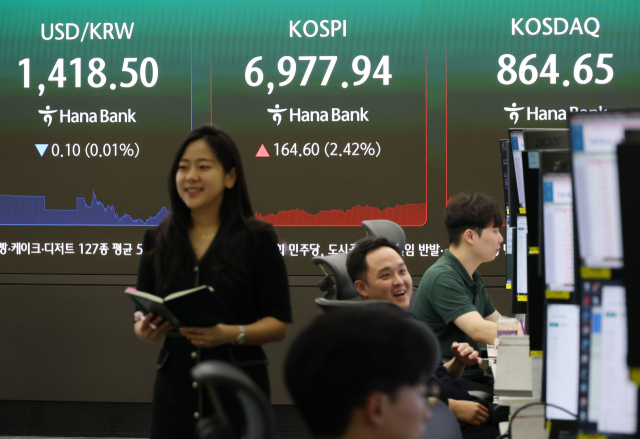
The last time the yen carry trade unwound, it was August 2024. A weak US jobs report collided with the BOJ’s rate decision. Within days, Japanese yen borrowing costs became prohibitive for traders who had been shorting the yen for years. The result: KOSPI dropped 8.8 percent. KOSDAQ — Korea’s tech-heavy board — fell 11.3 percent. Foreign investors pulled billions in a matter of hours.
That episode was not a anomaly to the Korea Financial Research Institute. It was a precedent. The report’s central thesis is straightforward: if the yen strengthens materially and the US-Japan interest rate gap narrows faster than markets expect, the same mechanism triggers again. The question is timing, not direction.
Here is what most English-language coverage of the situation misses: the severity of Korean market exposure is not widely understood outside Asia. The average US or European institutional desk pricing yen carry risk is still operating on models calibrated to the pre-2024 environment — an era of negative or zero Japanese rates and a yen that was effectively free money to borrow.
Who Is Exposed, and How Much
The mechanics are simple enough. The yen carry trade works like this: investors borrow yen at near-zero cost, convert it into higher-yielding currencies, and invest in assets denominated in those currencies — Japanese equities, emerging market bonds, Australian and New Zealand fixed income. The profit comes from the interest rate differential, not from the underlying asset’s performance.
When the yen strengthens, the math flips. Borrowers must now buy back yen at a higher price to repay their loans. If the move is sharp, forced selling follows. Assets get liquidated to cover the currency loss, which drives prices down further, triggering margin calls and more selling. The chain reaction is self-reinforcing.
Korea is a textbook target. Foreign ownership of KOSPI-listed stocks has historically hovered around 40 to 50 percent. Much of that foreign capital arrived through yen-funded carry positions. When those positions unwind, the first asset sold is often the most liquid one — and Korean equities, with their deep foreign participation and moderate volatility, fit that profile precisely.
The won-yen correlation complicates matters further. Historically, the two currencies move in the same direction. A stronger yen can temporarily ease upward pressure on the won-dollar rate, which sounds like good news for Korean importers and the current account. But that same yen appreciation signals risk-off behavior — and risk-off behavior in Korea has always meant equity selling, regardless of what happens to the exchange rate in isolation.
Why This Could Play Out Differently This Time
The Korea Financial Research Institute struck a cautiously measured tone. It noted that a large-scale liquidation event is not imminent. The US-Japan rate gap remains substantial, and the BOJ has signaled it will proceed carefully on further hikes. These are real constraints on how fast the carry trade can unwind.
But caution is not the same as safety. The report itself acknowledged that the speed of the yen’s recovery matters more than the outcome. A gradual shift allows markets to adjust. A rapid shift does not — and the US-Japan intervention coordination introduces precisely the kind of sudden directional move that triggers cascade liquidations.
What makes the current setup distinct from August 2024 is the active role of the US Treasury and Federal Reserve. In 2024, the yen’s move was largely driven by market forces reacting to Japan’s policy shift. Today, Washington and Tokyo are explicitly coordinating to push the yen higher. That means the currency move is not waiting for organic economic data — it is being engineered. Engineered moves do not respect technical support levels.
Who Wins, Who Loses
If the yen continues to strengthen and carry positions begin to unwind, the winners are clear: Japanese exporters facing a weaker yen headwind, Japanese bondholders seeing real yields turn positive for the first time in decades, and emerging market central banks that have been quietly building reserves as a buffer.
The losers are also identifiable. Korean and other Asian equity holders with concentrated foreign capital are first in line. Emerging market bond funds with significant yen-funded exposure face redemption pressure. Companies in Korea with dollar-denominated debt and weak current accounts will feel the squeeze as the broader risk-off narrative takes hold.
Global hedge funds that bet on continued yen weakness — a position taken by many prominent macro players over the past three years — are the most exposed. Their P&L is directly linked to the assumption that the BOJ will remain dovish. That assumption has just been downgraded.
What Comes Next
The Korea Financial Research Institute’s report should be read as a warning about structural risk, not a call to evacuate markets today. The BOJ is moving slowly. The US-Japan rate gap is still wide. The intervention impact may prove temporary if the fundamental drivers of yen weakness — Japan’s persistent trade deficit, demographic drag, and structural deflation — remain intact.
But the risk has shifted from theoretical to operational. Any future BOJ hike above 1 percent, any further US-Japan coordination, or any unexpected US economic data that weakens the dollar could reignite the unwind. The August 2024 playbook already exists. The question is whether Asian equity markets are positioned for it — and whether global investors finally understand how much they have left on the table.
The carry trade built its empire on the assumption that the yen would stay weak forever. That assumption is now expired. The question is whether the market prices that reality in gradually — or all at once.