Apple's Foldable iPhone Signals a Decisive Break From Qualcomm—And It Reshapes Everything
Apple's first foldable phone, the iPhone Duo, launches at $1,999 with an in-house C2 modem that cuts Qualcomm dependency. What this means for Samsung's foldable dominance, Korea's supply chains, and the global handset hierarchy.
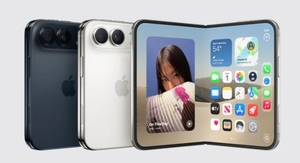
The Product: A Foldable That Actually Looks Like Apple Designed It
Apple’s first foldable phone—the iPhone Duo—arrives with a price tag of $1,999, a release date of October 23 in US stores, and a design philosophy that openly mocks every foldable that came before it.
New CEO John Turners didn’t just unveil a new form factor. He delivered a verdict. “Previous foldables feel like two phones awkwardly connected,” he said during the September event. The iPhone Duo, passport-sized with displays on both the interior and exterior, is Apple’s answer to that problem—and it’s calibrated to make competitors look clumsy by comparison.
This matters because Apple has never entered a hardware category without declaring it wrong. The iPhone killed the BlackBerry. The Apple Watch told smartwatches to grow up. Now the iPhone Duo is doing the same thing to Samsung’s Galaxy Z series—and it’s doing it from a position of strength.
Inside, iOS has been substantially redesigned for dual-screen use. Two apps run simultaneously. Apple Pencil is supported. The software isn’t bolted onto a new hardware shape; it’s been re-architected for it. That’s the difference between a genuine platform play and a gimmick—and Apple is making a platform play.
The pricing is aggressive in its own way. $1,999 puts the Duo well above the iPhone 18 Pro at $1,199, but below where Samsung’s Z Fold series has been creeping. Apple is signaling that foldables aren’t a niche experiment anymore—they’re the next iteration of the iPhone, priced for people who already buy iPhones.
The Modem: A Quiet Revolution in Apple’s Supply Chain
Here’s what most coverage is missing: the C2 modem Apple announced alongside the iPhone Duo isn’t just incremental. It’s structural.
The C2 is Apple’s second-generation in-house cellular modem. Speed is 50% faster than the previous Apple modem. Energy consumption drops 15%. And critically, it reduces dependency on Qualcomm—the single largest supplier of cellular baseband chips for iPhones today.
Johnny Srouji, Apple’s senior vice president of hardware technologies, framed it as a user experience story: AI-driven signal recovery in weak-coverage areas, faster reconnection, better reliability. But the business story underneath is far more dramatic. Apple is building the thing it buys the most of—and doing it to stop buying it.
Analyst Ben Bazarin projects that Apple will likely exclude Qualcomm chips entirely from the iPhone 19 series next year. If that happens, it would be the first iPhone without a Qualcomm baseband since the original iPhone 3G in 2008. Twenty years of dependency, erased in a single product cycle.
This isn’t just about modems. It’s about Apple’s willingness to vertically integrate every layer of its hardware stack—from the A-series chips to the modem to the display drivers. The iPhone Duo is the first product to showcase that integrated approach in a category where integration was previously impossible. Now it’s possible, and Apple is demonstrating why it matters.
The Samsung Problem: Folding Under Pressure
Samsung has owned the foldable category since the Galaxy Fold launched in 2019. It’s built display technology, supply chains, and brand perception around the form factor. The iPhone Duo isn’t just competition—it’s an existential challenge to Samsung’s narrative that foldables are its future.
Apple’s entry changes the math in three ways:
First, Apple brings an installed base of nearly 2 billion active iPhones. Samsung’s foldable customer base is measured in the low millions. Even a small conversion rate from iPhone users to foldable users generates more volume than Samsung’s entire current foldable lineup.
Second, Apple’s software integration advantage is immediate. Samsung’s One UI has spent years adapting to foldables. iOS has been redesigned from scratch for dual-screen use. The gap in polish and workflow isn’t just noticeable—it’s probably wider than Samsung expects.
Third, and most damageingly, Apple is framing foldables as the natural evolution of the iPhone, not a separate category. That’s a branding move that undercuts Samsung’s positioning as the foldable pioneer.
Samsung’s response will depend on whether it doubles down on display innovation or tries to compete on price. Either path is difficult. The former requires capital Apple isn’t racing to match. The latter sacrifices margins Apple can absorb more easily.
The Korean Supply Chain: Winners, Losers, and Uncertainty
Korea sits at the center of this story in ways that aren’t immediately obvious.
Samsung Display is the primary OLED supplier for Apple’s iPhone lineup. If the iPhone Duo ships with a dual-OLED foldable panel, Samsung Display stands to gain significant revenue—but only if Apple continues relying on Korean suppliers for the display itself. The C2 modem announcement suggests Apple is moving toward self-sufficiency in chips, but displays remain a different calculus.
SK Hynix and Samsung Electronics share memory and storage supply contracts with Apple. The article notes that Apple raised Mac and iPad prices this summer due to surging memory and storage costs. Component pricing pressure is real, and Korean memory producers are well-positioned—but at the margin.
LG Display, another major Korean OLED supplier, faces a more complicated trajectory. Apple has historically favored Samsung Display for iPhone panels. LG’s entry into Apple’s foldable supply chain would depend on whether Apple diversifies or consolidates—a decision that hasn’t been made public.
The C2 modem itself is a non-Korean product for now. Apple designs it; TSMC almost certainly manufactures it. But Apple’s broader strategy of reducing Qualcomm dependency could reshape the global modem market in ways that indirectly affect Korean semiconductor companies that serve Qualcomm’s supply chain.
The Global Handset Market: A New Hierarchy Takes Shape
Apple’s move reorders the smartphone competitive landscape. The hierarchy that emerged in the 2010s—Samsung at the top of Android, Apple at the top of iOS, Chinese brands competing on price—fractures when Apple enters a category Samsung had claimed as its own.
Chinese manufacturers like Huawei and Xiaomi are foldable pioneers in their own right, but they lack Apple’s ecosystem lock-in and brand halo. Their foldable strategies remain regional. Apple’s entry globalizes the category overnight.
Qualcomm, meanwhile, faces a strategic crossroads. The company has built its mobile business on iPhone baseband contracts. Losing that revenue stream—projected within 12–18 months—would force a pivot toward Android OEMs, automotive, and IoT. The company’s stock and its workforce would feel the transition.
For the broader market, Apple’s foldable launch raises the bar on durability, software integration, and ecosystem support. Samsung will need to respond with meaningful innovation, not just iterative updates. The foldable category was maturing slowly; Apple has accelerated the timeline.
What Happens Next
The iPhone Duo ships in October. Pre-orders for the iPhone 18 Pro line begin September 12. Prices across the board are trending upward—Apple raised Mac and iPad costs this summer, and the iPhone 18 Pro starts $100 higher than last year. The company is absorbing component cost inflation while investing in in-house silicon.
The C2 modem’s real-world performance will determine whether Apple’s projection of a Qualcomm-free iPhone 19 is credible. Early benchmarks and carrier compatibility tests will be the proof points.
Samsung’s reaction—whether through display technology leaps, pricing adjustments, or ecosystem moves—will define the foldable war’s next chapter.
Apple has never entered a category as a follower. The iPhone Duo is a declaration that foldables are now an Apple category, not a Samsung one. The market will adjust to that reality over the next 12 months.