Houthi Gains at Bab el-Mandeb Buy Leverage but Cost Yemeni Legitimacy
The Houthis' seizure of Yemen's Red Sea coast gives Tehran a mirror chokepoint and pressures Saudi Arabia—but the movement's decade of ruling by force leaves it with territory it cannot politically hold.
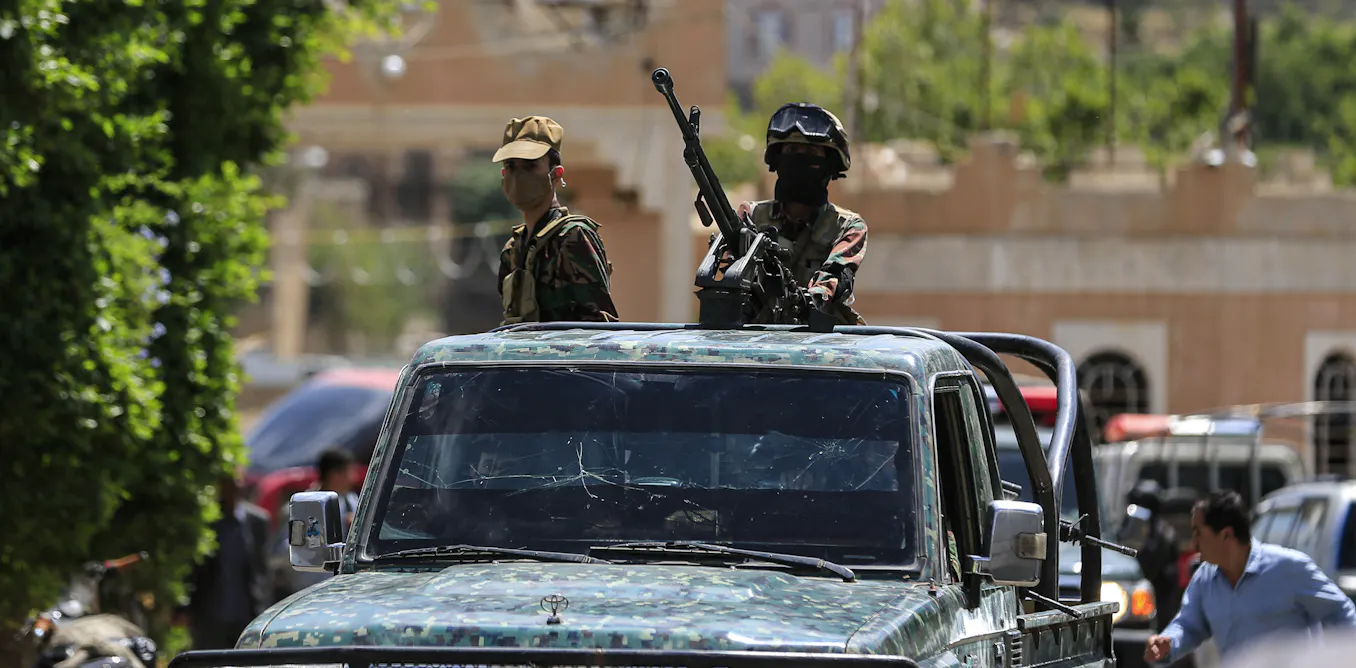
The ground snapped.
In eight days starting Sept. 3, 2026, Houthi forces swept through western Yemen and seized roughly 2,100 square miles of coastline, including the town of Mokha, the port district of Dhubab, and the island of Mayyun at the mouth of the Bab el-Mandeb Strait. The United Nations estimates more than 100,000 people fled the fighting, many boarding rickety boats for Djibouti. It is the sharpest shift on Yemen’s front lines since a U.N.-brokered truce froze them in April 2022.
Most coverage framed the offensive as a calculation for Tehran—a new lever against Washington and Riyadh, and a fresh threat to global shipping. That reading is correct but partial. The more consequential story is what this advance does to the Houthis themselves. They now control the Arabian Peninsula’s other great chokepoint. They still do not control Yemen.
The mirroring play
Since March 2026, Iran has effectively closed the Strait of Hormuz following U.S. and Israeli strikes on Iranian nuclear and military sites. In response, Saudi Arabia rerouted crude oil through Bab el-Mandeb at roughly eight times the rate it did a year earlier. Tehran has been charging vessels up to $2 million per ship for safe passage through Hormuz. Houthi control of the southern strait hands Iran a mirror-image lever—and Yemeni security sources confirm that a senior Iranian commander, Abdul Reza Shahlai, was on the ground in September overseeing part of the operation.
The economic incentive for the Houthis is obvious. If they can extract tolls or threaten shipping the way Iran does, they gain revenue and bargaining power after a decade of ruin.
But the timing also reflects opportunity. The anti-Houthi coalition in southern Yemen has fracted further after the United Arab Emirates withdrew its support for those forces in late 2025, following a Saudi-Emirati rift. With Riyadh distracted by a broader regional war and southern Yemeni troops exposed along the coast, the Houthis judged the moment favorable.
They also had a casus belli close to hand. On July 13, Yemeni government forces backed by Saudi Arabia struck the runway at Sanaa airport, forcing an Iranian Revolutionary Guard Corps aircraft to turn back. The Houthis declared their ceasefire with Riyadh over that attack, struck the Saudi city of Abha’s airport within hours, announced a naval blockade a week later, and opened a missile campaign in early August—weeks before the ground offensive began.
That sequence suggests more than spur-of-the-moment retaliation. Something more deliberate was in motion.
Forcing Riyadh back to the table
Perhaps the Houthis’ central bet is that escalating inside Yemen is the surest way to drag Saudi Arabia back to negotiations. As recently as 2023, Riyadh and Sanaa had been discussing a comprehensive nationwide ceasefire that would have lifted key Saudi restrictions on Houthi governance. The talks collapsed after the Red Sea crisis of late 2023 and 2024, when the Houthis ramped up attacks on commercial shipping in solidarity with Gaza—and Riyadh has shown little urgency to revive the process since.
The Houthis may now believe they hold better cards. Control of the strait gives them something Riyadh cannot ignore: the ability to raise the cost of business-as-usual overnight. The goal, Houthi officials insist, is not to serve Iran but to secure the political recognition they have wanted all along—not merely the economic concessions Saudi Arabia floated in 2023, but a settlement that acknowledges Houthi authority over large parts of Yemen.
They have been careful to frame the operation as a sovereign, national act. Houthi-affiliated sources report that within days of taking Mokha, the group reopened the port’s customs house, cut fees and duties by nearly half, distributed 20,000 food baskets across the coastal districts, and offered a general amnesty to the fighters who had held the coast. A week later, Houthi leader Abdulmalik al-Houthi told southerners directly that his forces were not targeting them, only the troops Saudi Arabia had brought in.
This is legitimacy performed after conquest. It is also the limit of what military victory can produce for a movement that has never pursued a political bargain.
The legitimacy ceiling
No government in modern Yemeni history has held both military and political supremacy over the country’s full territory. The Houthis control much of the northwest. They have never governed the south or east, and they have shown no appetite for the kind of power-sharing arrangement that could make their gains durable. Their modus operandi has always been rule by guns, not coalition.
A decade of Houthi administration in Sanaa offers a preview: centralized authority, limited inclusion, and persistent friction with every other center of power. The coastal offensive repeats the pattern. Reopening a port and slashing customs fees does not substitute for a political settlement. Handing out food baskets does not answer the question of who decides for Yemeni southerners.
Worse, the operation invites a perception the Houthis have spent years trying to shed. Seizing the strait and banning Saudi shipping through it makes the movement look, to much of the world and no small part of Yemen, like Tehran’s instrument—regardless of what its own objectives may be. That reputation is a strategic liability. It strengthens Riyadh’s case for treating the Houthis as an extension of Iranian power rather than a Yemeni political actor worthy of negotiation. And it gives the Houthis’ enemies a ready justification for responding with force.
Saudi Arabia has prosecuted the war in Yemen for over a decade at enormous civilian cost. Few expect Riyadh to attempt a ground invasion to retake Sanaa. But the Houthis have now exposed themselves—and the civilians caught between them and Saudi air power—to the possibility of relentless airstrikes. Escalation cuts both ways: the leverage the Houthis gain at Bab el-Mandeb may be matched by the damage their positions absorb from the sky.
What happens next
The Houthis have achieved something remarkable in eight days: the largest territorial shift since 2022, control of a strait that handles a significant share of global shipping, and a renewed seat at whatever table Riyadh might be willing to reopen. They have also deepened Iran’s strategic position and given Tehran a chokepoint that mirrors Hormuz.
But they remain a movement that has never converted military supremacy into political consent. Taking the coast is one thing. Governing it in a way that convinces Yemenis—and the outside powers invested in Yemen—to accept Houthi authority is another. The tolls they could collect, the leverage they can exert over Riyadh, and the attention they can force from Washington all depend on holding what they have seized. Holding depends on something the Houthis have so far refused to build: a political framework broad enough to survive the guns that put them in power.
That gap between territory and legitimacy is where this crisis will be decided—not on the decks of container ships transiting Bab el-Mandeb, but in whatever negotiations follow the bombing.