Korea's Buyback Lifeline Is Running Out
KOSPI collapsed nearly 4% as Middle East tensions and surging US yields hammered the market. The only thing holding back a deeper rout was corporate buybacks — a sign of fragility, not resilience.
The Buyback Floor Is Showing Cracks
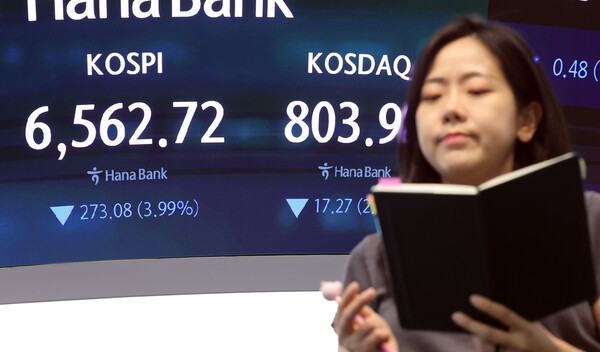
Korea’s stock market lost 4 percent in a single session on October 2, pulling the KOSPI down to 6,562 — the first three-day streak of losses since late September. Foreign investors and domestic institutions unloaded nearly 4 trillion won in combined net selling. What kept the index from sinking further wasn’t optimism. It was a mirror:
South Korea’s two largest technology companies, Samsung Electronics and SK Hynix, buying their own shares.
Other corporations absorbed 1.65 trillion won in net buying on the day, extending a streak of 11 consecutive sessions of purchases. That pattern has become the primary structural support for the KOSPI throughout 2025. Without it, the market would have fallen much further. With it, the market still fell nearly 4 percent.
The distinction matters because buyback-supported markets are not resilient markets. They are captive ones. The buying is not coming from conviction or inflows from abroad. It is coming from corporate treasuries responding to regulatory encouragement and share-price targets set by management teams who would rather recycle capital into their own stock than into expansion or R&D.
The Shock Was Familiar, the Scale Wasn’t
The mechanics of the sell-off were textbook. Oil prices jumped 5.2 percent to $90.22 a barrel as renewed US-Iran hostilities raised fears of supply disruption. The yield on the US 10-year Treasury climbed to 4.79 percent, the highest level since January 2025. Higher yields mean a stronger dollar and tighter financial conditions — both headwinds for emerging-market equities.
Overnight, Wall Street sold off. The Philadelphia Semiconductor Index dropped 2.1 percent. Chinese memory-chip maker ChangXin Memory Technologies announced it had begun small-scale production of HBM3E chips, the same high-bandwidth memory category that has powered SK Hynix and Samsung’s growth thesis. The news added a competitive dimension to the existing macro pressure.
Samsung Electronics fell 4.02 percent. SK Hynix fell 4.73 percent. SK Square dropped nearly 8 percent. Hyundai Motor fell 5.6 percent. LG Energy Solution shed 5.3 percent. Across the KOSPI, 735 of 911 traded stocks declined. Market capitalization slipped below 6,000 trillion won for the first time in seven sessions.
The KOSDAQ also broke below 800, closing at 803.98 after touching 796 during intraday trading. Institutional sellers dominated there as well, offloading 232 billion won, while retail and foreign buyers attempted — unsuccessfully — to provide support.
What the Numbers Say About Fragility
Here is the pattern that international investors miss when they read a headline about a one-day selloff: Korea has been running on a narrow set of supports for months. The corporate buyback program is real and substantial, but it is also finite. It does not scale with market stress — it shrinks precisely when the market needs it most, because company balance sheets are under pressure from the same oil and rate shocks that are driving the sell-off.
Samsung Electronics and SK Hynix alone account for the bulk of the 1.65 trillion won in other-corporation buying. If either company pauses its repurchase program — as they might if earnings come under further strain from input-cost inflation — the KOSPI loses its primary bid support overnight.
Foreign investor selling of nearly 2 trillion won this session is also worth tracking. The pattern of foreign flow reversals in Korea tends to be sharp and self-reinforcing. When foreign funds exit, they do not drip out slowly. They accelerate. The question is not whether they will return — they usually do — but what price they will demand for coming back, and whether the corporate buyback cushion will still be there when they do.
The Real Story Is What the Buybacks Reveal
The broader implication is structural. Korea’s market is large enough to matter globally — it is home to some of the world’s most important semiconductor and battery producers — but it lacks the depth of domestic institutional demand that makes larger markets more shock-resistant. Pension funds, insurance companies, and mutual funds in Korea tend toward conservative allocations. Retail participation is significant but volatile. The gap between those two forces is being bridged, almost literally, by corporate treasury purchases.
That is not a sustainable equilibrium. Buybacks are a distribution of capital to shareholders, not a creation of productive capacity. They can support valuations in calm or moderately stressed periods. They cannot absorb sustained foreign outflows combined with rising global yields and commodity shocks.
The market’s recovery attempts during this session — the index briefly climbing back toward 6,694 before falling again in the afternoon — suggest that some participants were testing whether the buyback support would hold. It did not, convincingly. The second act of the day was a retreat, not a bounce.
What Comes Next
Several variables will determine whether this is a pause or the start of a deeper drawdown. Oil prices above $90 change the cost structure for an economy that imports nearly all of its energy. Korean manufacturing margins, already compressed, face further pressure. The Bank of Korea will likely find itself between a rock and a hard place: cutting rates risks currency depreciation and capital flight, holding rates steady risks choking growth further.
The US Federal Reserve’s stance on rates, signaled by the 10-year yield at 4.79 percent, remains the dominant external variable. If the yield climbs further, Korean equities become less attractive relative to dollar assets. If it stabilizes or falls, the pressure eases.
For now, the only question is whether the buyback program can survive the next shock. The answer will determine whether Korea’s market demonstrates the resilience expected of a major emerging economy — or the fragility of one that has grown dependent on its largest companies to prop up their own stocks.
The data from October 2 suggests the latter, for now. The market closed at 6,562. The buybacks continue. But the selling was faster.