POSCO and Hyundai Steel Forge Unlikely US Alliance to Beat Tariffs
South Korea's top two steelmakers are co-investing $5.8 billion in a Louisiana plant — a signal that Korean heavy industry is rewriting the rules of competition when trade walls close in.
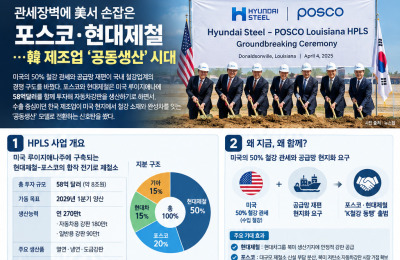
The Rivals Share a Furnace
POSCO and Hyundai Steel are not natural allies. They have spent years locked in a domestic price war, each trying to undercut the other on the very same orders from Hyundai Motor and Kia. Yet on September 4, in Donaldsonville, Louisiana, their CEOs stood side by side at a groundbreaking ceremony for a facility that will cost $5.8 billion to build.
The Hyundai Steel-POSCO Louisiana Steel plant — HPLS — is being financed with Hyundai Steel holding a 50% stake, POSCO 20%, and Hyundai Motor and Kia each taking 15%. Annual output will reach 2.7 million tons by the first quarter of 2029, of which 1.8 million tons will be automotive-grade steel sheet. Half of that capacity is already sold: 400,000 tons each to Hyundai and Kia, plus another 600,000 tons to POSCO’s existing customer base in North America. The remaining 1.3 million tons will be sold through Hyundai Steel’s established US distribution network and to other American automakers.
This is not merely a tariff dodge. It is a structural bet that the future of Korean industrial competitiveness in the United States belongs to companies willing to share risk, technology, and supply chains rather than compete on every line item.
Why Two Competitors Chose One Factory
The Trump administration’s 50% tariff on imported steel changed the math overnight. Korea’s export-oriented steel model — produce at home, ship across the Pacific, sell to US automakers at a markup eroded by tariffs — no longer makes sense. Building two separate plants, one for each company, would have doubled capital expenditure, doubled the footprint, and split the limited supply of skilled labor and logistics capacity in the American Southeast.
By sharing a single electric-arc-furnace (EAF) mill, POSCO and Hyundai Steel are dividing roles rather than fighting for the same yard. Hyundai Steel brings the volume and the automotive customer relationships baked into the Hyundai Motor Group ecosystem. POSCO brings process know-how in high-strength, low-carbon auto steel and a foothold in the broader North American market that Hyundai Steel has not yet penetrated. The ownership split reflects that division: Hyundai Steel, the majority owner, operates the plant; POSCO, the minority partner, contributes technology and gains access to a US-based production base without footing the full capital bill.
Hyundai Motor and Kia each hold 15% stakes precisely to lock in supply. The automakers are not passive off-takers here — they are co-investors with skin in the ground, guaranteeing demand for 800,000 tons of output regardless of where global steel prices move.
The Low-Carbon Angle Most Readers Miss
The press releases emphasize tariff avoidance. The real strategic thesis is decarbonization. Traditional Korean steel production relies on blast furnaces fueled by coking coal — an expensive and carbon-intensive model that faces mounting pressure from both US carbon-border adjustments and corporate fleet emissions targets. An EAF mill powered by scrap metal and direct-reduced iron (DRI) produces roughly a third of the CO2 per ton of steel. For American automakers under shareholder and regulatory pressure to lower Scope 3 emissions, steel produced in a low-carbon mill in Louisiana is materially more valuable than steel shipped from Busan.
Jeong Eisun, Hyundai Motor Group’s chairman, reportedly stated at the ceremony that the plant’s output could eventually extend beyond automotive into robotics and aerospace — sectors where lightweight, high-strength, low-carbon steel commands a premium. That framing suggests the venture is intended as a platform, not a one-product factory.
Who Wins, Who Loses
Hyundai Motor Group wins immediately. It secures a captive, tariff-free, low-carbon steel supply for its US assembly plants, shrinking the distance between raw material and chassis. Supply-chain risk drops. Lead times improve. Development cycles for new vehicle platforms can align with steel suppliers on North American soil rather than crossing an ocean.
POSCO wins a slower but strategically vital foothold. Rather than building a greenfield mill from scratch — a gamble that would have required $4 billion or more and years of permitting — POSCO gains production capacity in the US market within three years through a minority stake. The 600,000-ton commitment to POSCO’s own customers ensures the plant runs at meaningful utilization from day one, even if Hyundai Group’s internal demand fluctuates.
American automakers outside the Hyundai ecosystem stand to benefit from increased steel supply in the region, though they will pay market rates set by a plant partially captive to one integrated group. The US steel industry as a whole gains a new competitor that combines Korean process efficiency with American production costs — a combination that could pressure marginal US producers over time.
POSCO’s Korean competitors, particularly smaller steelmakers without US exposure, face a widening gap. The alliance between the two largest Korean producers raises the bar for who can compete in North America. Smaller firms that relied on exporting to the US will find the tariff wall higher and the path to local production more expensive now that the incumbents have already shared a furnace.
What Could Go Wrong
The risks are real and concentrated in three areas: cost, policy, and demand.
Construction costs for a greenfield EAF mill in the United States are substantially higher than in Korea. Labor, environmental compliance, and logistical expenses in rural Louisiana will test the $5.8 billion budget. If cost overruns materialize, margins on automotive steel — already a relatively low-margin product — could compress further.
Policy risk cuts both ways. A future US administration could raise tariffs further, which would help HPLS by making imported steel more expensive, or it could relax trade restrictions, which would reduce the plant’s strategic advantage. Energy policy is equally uncertain: the economics of an EAF mill depend heavily on electricity and natural gas prices, both of which are subject to regulatory shifts. A change in US energy policy that raises power costs in the Southeast would hit HPLS harder than Korean producers competing on domestic cost.
Demand risk is the third variable. The 2.7-million-ton capacity assumes North American auto production remains robust through the late 2020s. If electric-vehicle adoption slows, or if US auto sales contract under recessionary conditions, the plant could operate below the 1.4-million-ton off-take agreement baseline, leaving the remaining capacity to be sold on a weakening spot market.
The Bigger Pattern
The HPLS joint venture is likely the first of several similar arrangements across Korean heavy industry. When trade barriers rise, the instinct is to fortify national champions. The smarter instinct — and the one POSCO and Hyundai Steel appear to be testing — is to merge competitive strengths at the point of friction.
Other Korean manufacturers facing similar tariff walls in the US, from batteries to semiconductors to shipbuilding components, will watch this plant closely. If HPLS reaches 80% utilization by 2030 and delivers auto steel at a cost competitive with both Korean exports and US-produced steel, the “Korean steel alliance” model will have legs. If it struggles with cost overruns or low utilization, it will serve as a cautionary tale about overcommitting to shared infrastructure in an uncertain trade environment.
The groundbreaking has passed. The real test begins when the first ton of steel pours in 2029.