Trump Renames Lake Ontario — But Canada Isn't Alone in Losing Sleep
Trump's executive order renaming Lake Ontario to Lake America is the latest escalation in a trade war that could ripple far beyond North America — including into Korea's investment calculus.
A Lake, a Name, and a Tariff War
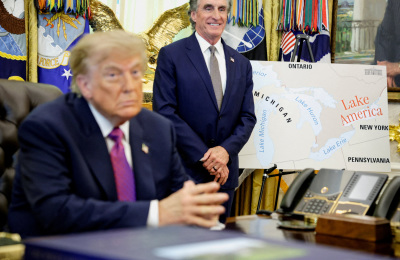
Donald Trump signed an executive order on August 27 renaming Lake Ontario to “Lake America” — and directed the US Geological Survey’s Geographic Names Information System (GNIS) to update its records immediately. It sounds like the opening move of a surreal comedy. It isn’t.
The order came 13 days after the US imposed 50% tariffs on $20 billion in Canadian goods. Canadian Prime Minister Mark Carney responded with up to 50% retaliatory tariffs on an equivalent value of American products. Trump has now threatened an additional 50% levy on Canadian cars and auto parts starting next January. The lake renaming is not separate from the trade war. It is a message — theatrical, petty, and deliberate.
Ontario Premier Doug Ford, who had called Trump a “loser,” faces the renamed waterway on his province’s doorstep. New York Governor Kathy Hochul, a Democrat, said her state will not recognize the change. Canada’s government is expected to follow suit. The GNIS list will read “Lake America.” Maps in Toronto will still say “Ontario.” Two governments, one body of water, zero compromise.
Trump framed the move as justified because the deepest part of the lake lies within US territory, giving America “the majority” of the water volume. He also hinted the Atlantic and Pacific Oceans might be next, citing his earlier renaming of the Gulf of Mexico to “America Gulf.”
What the Renaming Actually Does
The practical impact of the renaming is thin but symbolically loaded. GNIS is a US federal database; it has no authority south of the border and no mechanism to override existing international treaties, including the 1909 Boundary Waters Treaty that governs shared waterways. Canadian surveys, provincial road signs, and Navigation Canada charts will continue using the traditional name. International hydrographic bodies, including the International Hydrographic Organization, have not been notified of any change and are unlikely to adopt one unilaterally imposed by a single nation.
What the order does accomplish is legal and bureaucratic friction. US agencies, defense contractors, and engineering firms that rely on GNIS data for mapping, environmental compliance, and procurement will now cross-reference two conflicting toponyms. Supply-chain software, GIS platforms, and logistics systems fed by federal data streams will need corrections or workarounds. For Korean companies with US-based logistics partners or joint ventures, every shipment manifest, customs filing, and environmental report becomes a minor compliance exercise.
This is the second-order cost of a symbolic act: it externalizes administrative burden onto businesses that had no role in the dispute. The cost is spread across thousands of firms, making it politically invisible. But it is real.
What Korea Should Understand
Korean media covered the naming dispute primarily as diplomatic theater. That misses the signal.
Canada is South Korea’s 11th-largest trading partner and a critical node in the North American supply chain — particularly for automotive parts, raw materials, and increasingly, semiconductor equipment. When the US and Canada cannot agree on the name of a lake, Korean companies already operating in Mexico or eyeing a North American footprint pause and recalculate.
SK Hynix, for example, just announced the groundbreaking of its first US production base in West Lafayette, Indiana — not in the familiar Arizona-Texas corridor where most chip fabs cluster. The decision followed a two-year competition and came with a staggering support package: $554.7 million in tax rebates from Indiana, $80 million in conditional performance grants, $45 million from the federal CHIPS Act in direct subsidies, and up to $500 million in loans. Purdue University contributes research and talent pipelines. All of this was built on the assumption that North American trade rules would remain at least predictable enough to justify a $15 billion commitment in a single location.
That assumption is now tested by a president willing to rename geographical features as leverage.
The risk is not that tariffs will go up — they already have. The risk is that the framework behind them becomes unstable. If trade policy can be expressed through arbitrary name changes on US government maps, then every contract, every supply-chain agreement, and every facility investment in North America carries an unpriced political variable. Korean multinationals with US operations or plans are sitting in that uncertainty right now.
Second-Order Effects on Korean Business
The implications extend well beyond memory-chip fabs. LG Energy Solution has spent years positioning battery plants in Michigan and Tennessee, counting on stable US-Canada-Mexico trade flows under the USMCA. Hyundai Motor and Kia have deep integration with Ontario-based parts suppliers — the so-called Motoplex along the 401 corridor. When tariff thresholds shift overnight, those integrations face immediate cost reassessment. The question is not whether Korean firms will absorb the hit or relocate components, but how quickly they can re-map a supply chain that took two decades to build.
Even firms without direct Canadian exposure are affected. Korea’s broader export strategy relies on the assumption that the US will act as a predictable anchor in the region — a market with rule-bound enforcement, not rule-by-decision. The lake renaming contributes to a pattern in which Korean policymakers and corporate strategists must now factor in a baseline of unpredictability. Insurance costs rise. Hedging strategies grow more complex. Long-term capital commitments become harder to justify.
Who Wins, Who Loses
Trump wins headlines and satisfies a domestic audience that views Canada as a long-standing trade cheater. The executive order costs nothing to implement and generates endless coverage. Ford gets bruised but stands on home turf. The Canadian public, already mobilized against US tariffs, rallies around a symbolic grievance that is easy to communicate and hard to dismiss.
Canada loses credibility with its largest trading partner and faces a 50% tariff wall on $20 billion of exports — roughly 4% of Canada’s total trade with the US. The automotive sector, already strained by the looming January deadline, will feel it first. Plants in Windsor, Oakville, and Brampton may accelerate restructuring plans that were already under discussion.
Korea loses a dimension of forecastability. Every major Korean exporter with US exposure — Hyundai Motor, Samsung Electronics, LG Energy Solution, SK Hynix — now calculates risk against a US administration that treats geographic nomenclature as a bargaining chip. The practical question is not whether Korea will face secondary tariffs; it is whether the rules governing existing ones will shift before the next quarter.
What Happens Next
Canada will not comply with the GNIS change. The name “Lake Ontario” will persist on Canadian and most international maps. But compliance is not the point — the point is signal.
Watch for three developments in the coming months: first, whether Trump follows through on the January auto-parts tariff threat; second, whether any Canadian provinces or US states begin striking side deals that bypass Washington; and third, whether Korean firms accelerate or delay North American investment decisions in response to the volatility. SK Hynix’s Indiana project is already grounded. Other Korean capital already in motion — battery plants, chip packaging, automotive joint ventures — may face fresh review.
A lake’s name is not a trade policy. But in this administration, everything is a trade policy. And the firms that understand that — before they need to — will be the ones that adjust first.