Why a 4% KOSPI Crash Points to a Longer Suffering Ahead
A 4 percent KOSPI collapse on oil and rate fears is not just a market correction — it is a signal that emerging Asia is running out of room to absorb commodity shocks while central banks stay hawkish.
The Market That Was Supposed to Be Safe
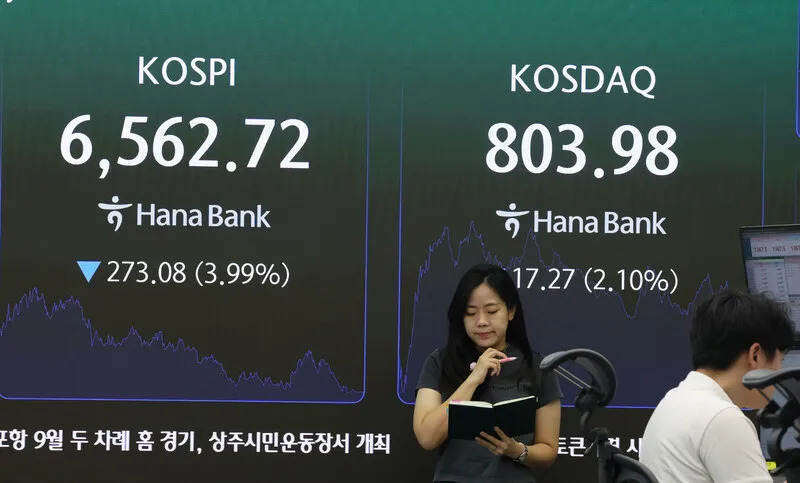
On June 2, the KOSPI shed nearly 4 percent in a single session, closing at 6562.72 — the lowest level in almost two weeks. Seven hundred thirty-five out of 915 listed stocks fell. Foreign investors pulled out 1.9 trillion won. Domestic institutions sold another 2 trillion won. The selling was not selective. It was broad.
What made this move striking was not the magnitude alone — Korean markets have seen worse days — but the timing and the combination of forces behind it. Oil prices surged on renewed US-Iran tensions. US Treasury yields climbed alongside Japanese and European rates. Three major advanced economies were tightening in sync for the first time in years, and the shock hit the most exposed emerging market in the room.
The pattern should not be surprising to anyone who has tracked how often Asia bleeds when commodities spike and dollar liquidity tightens at the same time. What should give pause is how fast the market has moved from euphoria to fear.
The Oil-Rate Combo Is the Real Threat
International benchmarks told the story in one day. West Texas Intermediate crude for October delivery rose 5.2 percent to $90.22 a barrel. Brent crude for November rose 4.6 percent to $94.65. Those are not modest moves. They are the kind of jumps that flip inflation expectations from dormant to aggressive.
Lee Kyung-min, a researcher at Daishin Securities, noted that the oil surge reignited inflation fears and put upward pressure on bond yields across major economies. That linkage matters because it means the market cannot simply hope that higher oil is temporary. If oil stays elevated, central banks cannot cut — and if central banks cannot cut, equities lose their primary support.
Kevin Wash’s hawkish remarks at the Federal Reserve, combined with growing concerns about the US fiscal trajectory, have reinforced the view that the high-rate environment will persist through the second half of the year. That is not a forecast wrapped in caution. It is the consensus now.
Asia Fell Together. That Is Not an Accident.
When the KOSPI dropped 4 percent, Japan’s Nikkei 225 fell 2.85 percent and Taiwan’s TAIEX dropped 1.67 percent. The regional sell-off was simultaneous, not sequential. That tells you something important about transmission channels.
In a normal cycle, emerging Asia can buffer itself through trade flows, currency flexibility, or capital repatriation. None of those tools work well when the dollar strengthens on rate fears and commodity import bills rise at the same time. Korea imports nearly all of its crude. Taiwan depends on semiconductors that lose pricing power when discount rates rise. Japan, despite its recent yen weakness, faces import inflation that squeezes household demand.
The result is a region where the good half of the year — driven by the semiconductor supercycle and early earnings surprises — is giving way to a second half that looks increasingly constrained by exactly the forces that make monetary policy rigid.
Who Pays the Price Now
Foreign investors are the most visible losers in the immediate term. Their 1.9 trillion won exit on June 2 was part of a broader risk-off posture that extends far beyond Korea. But the deeper casualty may be domestic confidence.
Park Hyung-jung, an economist at Woori Bank, warned that if major advanced economies raise rates in tandem, Korean rates will follow — creating a vicious cycle where higher borrowing costs depress equity valuations, depress growth expectations, and feed back into currency weakness. In his words, the kind of sharp rally seen in the first half of the year driven by semiconductor excess demand is unlikely to repeat anytime soon.
That is a significant downward revision in tone. The semiconductor boom had been the anchor narrative for Korean equities, and it is now being questioned not because fundamentals have collapsed, but because the macro backdrop makes future earnings less valuable in present-dollar terms.
What the Numbers Actually Say
Let us be specific about what a 4 percent single-day drop to 6500 means in context. The KOSPI had been riding high on AI and chip-driven momentum. A move of this size wipes out weeks of gains and resets valuation multiples across sectors that were pricing in continued liquidity support.
With 735 of 915 stocks lower, this was not a rotation. It was a repricing. And the sectors most exposed — financials, industrials, consumer discretionary — tend to feel rate sensitivity fastest. Materials and energy, often cited as beneficiaries of oil spikes, will not offset the drag if the broader economy slows.
For emerging market investors, the lesson is straightforward. Portfolios that were concentrated in Asia-driven growth names without hedging against commodity or dollar moves are now paying for that assumption. The market does not punish vulnerability slowly. It punishes it all at once.
The Hard Part Ahead
The most uncomfortable truth is that the conditions driving this sell-off are self-reinforcing. Higher oil keeps inflation data hot. Hot inflation keeps central banks hawkish. Hawkish central banks keep yields elevated. Elevated yields keep equities under pressure. The loop closes whether anyone wants it to or not.
Korea is particularly sensitive because its current account, while still positive, narrows whenever oil prices climb sharply. Its currency absorbs some of the shock, but not enough to insulate the stock market. And its policy rate, already moving higher in line with global trends, has less room to maneuver if growth slows unexpectedly.
The question for investors is not whether the next few months will be painful. It is whether the pain will accelerate or plateau. A sustained oil price above $90 per barrel, combined with Fed funds rates that stay elevated, points toward the former. A quicker-than-expected de-escalation in the Middle East could buy time — but it would not rewrite the structural problem.
What emerged clearly on June 2 is that the era of easy tailwinds for Asian equities may have ended. The semiconductor boom bought a window. The oil-price shock just closed it.