Why Kakao Is Running Self-Driving Cars Through Gangnam at Night
Kakao Mobility has spent months navigating Gangnam's chaotic nighttime streets not just to test hardware, but to hunt for the edge cases that will make autonomous vehicles viable in the real world. The strategy reveals a lot about Korea's bet on Level 4 autonomy.
The Gangnam Gambit
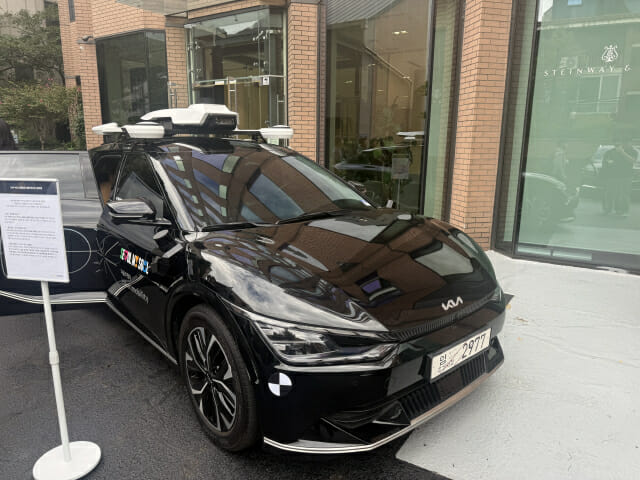
Kakao Mobility has been running six autonomous taxis through Gangnam between 10 p.m. and 5 a.m. since March. They have covered more than 13,000 kilometers and completed over 2,000 trips. The numbers sound modest compared with Waymo’s tens of millions of miles. But the strategy behind them is anything but modest.
The company is not testing its self-driving AI in empty industrial parks or sun-drenched California suburbs. It is deliberately placing those cars on the most chaotic urban roads in South Korea — streets where illegal U-turns are routine, construction lanes swallow whole lanes overnight, drunk pedestrians stumble into crosswalks, and delivery drivers drop cargo without warning.
Data quality over data volume
The conventional wisdom in autonomous driving has long favored mileage as the primary metric. Drive more, collect more data, improve the model. Kakao’s leadership is openly rejecting that assumption.
Im In-ho, who leads the AI driving team for autonomous vehicle development at Kakao Mobility, put it bluntly during a media briefing on September 9. “Driving for a year in easy conditions is worth less than a month in Gangnam” when it comes to AI improvement, he said.
The company’s approach centers on edge cases — those rare, unpredictable scenarios that do not appear in any textbook. An illegal U-turn made at 2 a.m. by a driver who thinks no one is watching. A lane shift caused by underground pipe construction that forces vehicles across the center line. A piece of cargo falling from a delivery truck onto a major boulevard. A group of bar-goers spilling into the road outside Gangnam Station.
The autonomous cars are equipped to automatically detect and save footage whenever the system switches from autonomous mode to manual intervention. That moment of human takeover is not treated as a failure — it is treated as data. Every instance is logged, then sent through a pipeline of refinement, auto-labeling, data mining, and model retraining before making its way back to the vehicle fleet.
Where this process once required humans to manually review driving footage, it now relies on servers that automatically analyze driving context alongside weather, time of day, road structure, and vehicle behavior. The shift from manual to automated labeling is a meaningful step — it dramatically scales the feedback loop between the road and the AI.
The end-to-end bet
Perhaps the most consequential announcement at the September 9 briefing was Kakao’s plan to introduce end-to-end autonomous driving technology by the end of the year. E2E systems connect sensor input directly to vehicle control through a single AI model, eliminating the traditional modular pipeline where perception, prediction, and planning are handled by separate software stacks.
The move signals confidence that the edge-case data collected in Gangnam has reached a critical mass. Kakao is essentially betting that its AI can now generalize from complex real-world scenarios without relying on hand-engineered rules at every decision point. If that works — and there is no guarantee it will — it could represent a significant leap in how Korean autonomous vehicles handle unpredictability.
If it does not, the consequences will be immediate and highly visible, since these vehicles operate on public roads with passengers.
The platform plays the long game
While the AI models get attention, Kakao is building something perhaps more strategically important: a unified platform that could define how autonomous ride-hailing works in Korea.
Kim Min-sun, who leads the autonomous driving business team, framed it this way: “The platform must replace the driver.” In a vehicle with no human behind the wheel, the app experience, dispatch logic, passenger guidance, and remote monitoring all need to function as a single coordinated system.
Kakao’s vision is a standard service platform that any autonomous driving technology provider could plug into. The idea is that a startup or a larger automaker building self-driving hardware could integrate with KakaoT’s demand side through a common protocol. That would make Kakao less a vehicle operator and more the operating system for autonomous mobility in Korea.
The platform also needs to solve problems that human drivers never had to think about. Kakao’s analysis of Gangnam roads found that only 2.3 percent of locations allow legal stops for passenger pickup and drop-off without violating traffic regulations. When there is no driver to wave someone down or negotiate a quick stop, the system must pre-define and guide passengers to specific boarding points. The company is already building features to direct riders to approved pickup zones through the app.
The AICS layer
Kakao is also developing an Autonomous Vehicle Integrated Control System, or AICS, that monitors vehicles, passengers, and road conditions simultaneously. Real-time monitoring and anomaly alerts are already operational. Remote support functionality — which does not involve a human directly controlling the vehicle but rather providing guidance like detour or U-turn instructions in construction zones, with the car making the final decision — is currently in the testing phase.
The company is experimenting with Vision-Language Models for its monitoring systems, a step that could significantly improve how autonomous vehicles interpret complex visual scenes in real time.
What stays human
Despite the ambition, Kakao is not yet operating fully unmanned vehicles on public roads. Construction zones still require manual intervention. Areas with active alcohol checkpoints are still managed by humans. Narrow alleyways where autonomous navigation is less reliable are currently driven manually.
The current service runs only six vehicles in Gangnam during nighttime hours. Daytime driving data collection began in June, but actual passenger service remains restricted to the overnight window. Kakao says it is evaluating expansion across time, geography, and fleet size — but only after safety validation proves sufficient.
Why the rest of the world should watch
Korea’s autonomous driving story is not getting the same global attention as American efforts, and that silence is misleading. Kakao is tackling one of the hardest problem spaces in the industry: dense, unpredictable urban environments with irregular traffic behavior. The edge-case-driven approach — prioritizing difficult scenarios over raw mileage — is arguably the right one, and it aligns with where the broader industry is beginning to head anyway.
The E2E transition planned for late 2026 is a meaningful milestone. If Kakao pulls it off with real passengers in Gangnam at night, it will have demonstrated something that few companies outside China and the United States have achieved: a Korean-made autonomous system capable of handling some of the most complex urban driving conditions on Earth.
The platform strategy adds another layer of significance. By positioning itself as the connectivity layer between autonomous vehicles and riders rather than just a vehicle operator, Kakao is setting up a model that other countries could adopt. The question is not whether autonomous taxis will reach Korea — it is whether Kakao’s architecture will become the default way those services are organized.
Right now, six cars are circling Gangnam’s streets from midnight to dawn, collecting data on illegal U-turns and drunk pedestrians and construction-zone chaos. The miles are modest. The implications, depending on how this year unfolds, could be far from it.