Witkoff and Kushner Enter the Ring: Can the US Force Russia-Ukraine Talks?
Trump's special envoys made their first trip to Kyiv after meeting Putin in Moscow, signaling a pivot toward direct trilateral talks. But the territorial gap remains enormous and winter is coming fast.
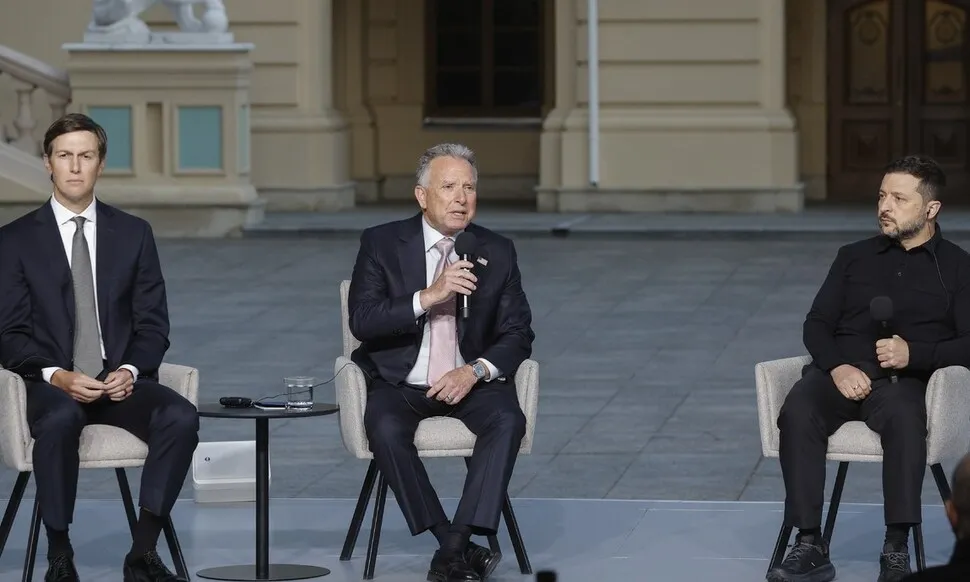
The Envoys Have Entered the Fray
Steve Witkoff and Jared Kushner walked into Kyiv on June 6 for the first time as Donald Trump’s official peace intermediaries. Six days earlier, they had sat across from Vladimir Putin in Moscow for more than three hours. The sequence itself tells you something: the Americans are no longer content to relay messages between hostile capitals. They want the Russians and Ukrainians in the same room.
That shift matters. For months, US engagement on Ukraine has been filtered through traditional diplomatic channels — or, more accurately, neglected entirely as the administration’s attention drifted toward what has become an all-consuming focus on Iran. Korean outlets like Hankyoreh have picked up on this pattern precisely because the story was getting quieter in English-language wire coverage, where the assumption was still that the Ukraine file was on pause.
It wasn’t. It was being reorganized.
The arrival of Witkoff and Kushner in Kyiv marks a structural recalibration of American posture, not merely a scheduling change. Their outsider status — one a real estate mogul with no prior diplomatic credentials, the other a senior adviser with no Senate-confirmed role — is itself a message. Trump is signaling that the old guard of the State Department, with its cautionary doctrines and institutional brakes, has been replaced by operators who treat diplomacy as deal-making rather than process management. That framing carries weight in Moscow, where Putin has grown skeptical of Western promises sustained by bureaucratic inertia. It also carries risk in Kyiv, where the memory of unfulfilled diplomatic gambits from 2022 and 2023 has not faded.
What Witkoff and Kushner Actually Heard
Witkoff called the Kyiv meeting “very substantive and important” and said he was “encouraged” by the discussions. Kushner repeated the Trump doctrine’s signature phrasing — that the goal is not merely ending the conflict but constructing a framework for “lasting and permanent peace.” Both men are outsiders to the foreign policy establishment, which means they are not bound by the institutional caution that typically slows crisis diplomacy. That is both their advantage and their risk.
Zelenskyy’s response was strategically calibrated. He said Ukraine would do “everything possible” to make a trilateral meeting happen, or a meeting that includes European partners. The wording is deliberate — he did not say he would attend a meeting without Europe. The British, French, and German national security advisors were in the room for the final session, and their presence suggests Washington is trying to avoid the appearance of a bilateral US-Russia deal that leaves Kyiv on the margins.
But appearances matter less than substance, and the substance is stark. Behind closed doors, Ukrainian officials conveyed what is by now a familiar list: Russian troop levels remain elevated along the entire front, offensive operations continue across Donetsk and Kharkiv oblasts, and the pace of Russian advances, while slower than the breakthroughs of late 2024, has not halted. Ukraine’s position relies on the assumption that time favors Kyiv — that attrition will eventually force Moscow to the table on terms more acceptable to Kyiv. The envoys’ visit suggests Washington no longer shares that assumption. The US calculation appears to be that the longer the war drags, the more the strategic picture hardens in Russia’s favor, as Ukrainian manpower erodes and European fatigue deepens.
The Donbas Chasm
The territorial question has not moved. Zelenskyy restated his position clearly: the Donbas is the issue of this war, and hard questions about land must be resolved at the leader level. Russia continues to demand that Ukrainian forces withdraw from Donbas territories it does not currently control — a condition that amounts, in practice, to forcing Kyiv to surrender gains made over three years of fighting. Ukraine refuses.
Witkoff acknowledged the difficulty directly: “Both sides need to compromise to some degree and narrow the gaps between issues. It is very difficult, but we are working toward a successful diplomatic resolution.”
Translation: there is no breakthrough waiting. The gap is wide, and neither side is close to bridging it on its own.
The chasm is not merely territorial but constitutional. For Zelenskyy, any agreement that cedes Donbas territory without a formal guarantee of NATO membership or equivalent security architecture would represent a catastrophic political defeat — one that could unravel his government and legitimize the very aggression Ukraine has spent three years resisting. For Putin, any agreement that does not recognize Russian sovereignty over the annexed regions, including areas Moscow has not fully occupied, represents a strategic failure that cannot be sold to a domestic audience already conditioned to expect total victory. Between those two immovable positions lies a corridor narrow enough for no deal to pass through.
The Ceasefire That Wasn’t
The most telling detail from the trip is what the ceasefire actually looked like. Russia and Ukraine agreed to temporarily halt attacks on each other’s capitals — Kyiv and Moscow — during the negotiation window. Everywhere else, the war continued. Ukraine struck a refinery in Ryazan. Russia fired missiles and drones at multiple Ukrainian targets.
This is not a ceasefire. It is a negotiated pause in the most visible symbolic targets, designed to create the appearance of progress while the real fighting rages on. It is a diplomatic photograph, not a strategic shift.
The implications extend beyond optics. By allowing Russian military operations to continue in eastern and southern Ukraine, the arrangement entrenches the status quo of territorial control — the very frozen line that any peace deal would have to negotiate around. Each day of selective pause without comprehensive cessation strengthens Moscow’s bargaining position by consolidating gains already made. Ukraine bears the brunt of this asymmetry, absorbing continued frontline pressure while its leadership is asked to demonstrate flexibility at the negotiating table.
Winter Is the Real Deadline
While the envoys talked peace, Zelenskyy was blunt about what comes next. He said a war lasting through winter is highly probable and laid out a concrete request: a “winter package” covering air defense, Patriot interceptors, and energy infrastructure protection. Russia has been systematically targeting Ukraine’s power grid, and Zelenskyy expects the attacks to intensify as temperatures drop.
His most urgent concern is interceptor shortages. He called the lack of ballistic missile defense missiles a critical weakness. The US has indicated it plans to increase Patriot production next year, which Zelenskyy welcomed — but production timelines do not match winter timelines. This is a gap of months, not years, and every month without adequate air defense costs Ukrainian lives and infrastructure.
The winter deadline operates on two levels. On the immediate level, it is a humanitarian and military imperative — failure to secure energy infrastructure before temperatures fall could disable hundreds of thousands of homes and force mass displacement. On the strategic level, winter creates a narrowing window for diplomacy: if Kyiv cannot sustain its defenses through the cold months, its leverage at any negotiating table weakens considerably. Conversely, if Russia believes winter will break Ukrainian resistance, it has less incentive to offer concessions now.
This is the second-order effect that the envoys’ optimism glosses over: the timing of diplomacy and the timing of survival are misaligned. The Americans want to announce progress within weeks. Ukraine needs air defense by November. Those timelines do not intersect.
What Changes, and What Doesn’t
The structural shift here is procedural, not substantive. The US is now treating direct trilateral negotiation as its preferred format, moving away from the stop-and-start shuttle diplomacy that characterized much of the previous cycle. That is meaningful: it means Washington is betting that putting Moscow and Kyiv in the same room — with Americans buffering the exchanges — can produce something neither side could orchestrate alone.
But the contents of any agreement remain uncertain. The territorial question is unchanged. The military balance on the ground is unchanged. The political constraints on both Zelenskyy and Putin are unchanged. What has changed is the channel, not the landscape.
The Americans want to announce progress within weeks. The Kremlin and the Mariinsky Palace want different things, and neither is close to conceding. The European security advisors in Kyiv are signal-flares — their presence confirms that Washington is trying to build a coalition façade even as it pushes a US-brokered deal. But a façade is not a foundation. Without concrete movement on territory, security guarantees, or enforcement mechanisms, any trilateral meeting risks becoming performative — a stage for diplomatic theater rather than a mechanism for resolution.
Winter is coming. The question is whether diplomacy moves faster than the cold, and whether the US can deliver anything beyond promises before the ground freezes and the next phase of the war begins.